
In organic fertilizer production, the operating environment of compost turning equipment is notoriously harsh—high humidity, corrosive gases, and pervasive dust. For both trough-type (stationary) and self-propelled (mobile) compost turners, scientific daily maintenance is key to reducing failure rates and extending service life. This article outlines the maintenance differences between the two types of equipment and five general maintenance habits to help overseas users maintain their equipment independently when professional after-sales support is unavailable.
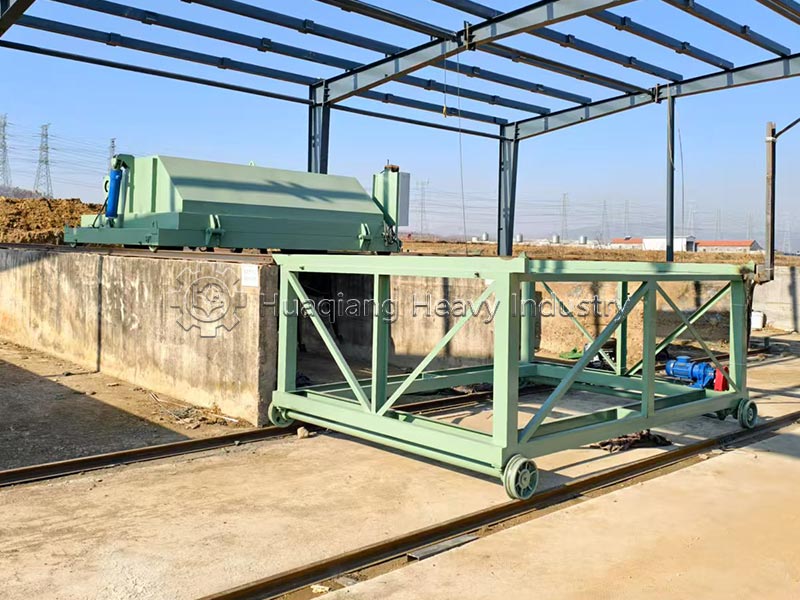
Trough-type compost turners operate on fixed tracks, so maintenance focuses on track cleanliness and wheel alignment. Material accumulation on the tracks can cause wheel jamming and track wear; long-term wheel misalignment accelerates wheel rim wear. For self-propelled compost turners, attention must be paid to tire/track condition and the steering system—insufficient tire pressure or improper track tension will increase resistance and power loss. Furthermore, the hydraulic steering system of self-propelled equipment requires regular checks of oil levels and seals.
Habit 1: Regular Lubrication, Avoiding Dry Running
The bearings, chains, and gearboxes of the compost turner are key areas for lubrication. Apply high-temperature grease to bearings every 50 hours of operation; apply grease to chains every 100 hours, maintaining appropriate tension; change the oil in the gearbox after the first 500 hours of operation, and then every 1000 hours or every six months. For self-propelled equipment, additional lubrication is required for the travel reducer and steering mechanism.
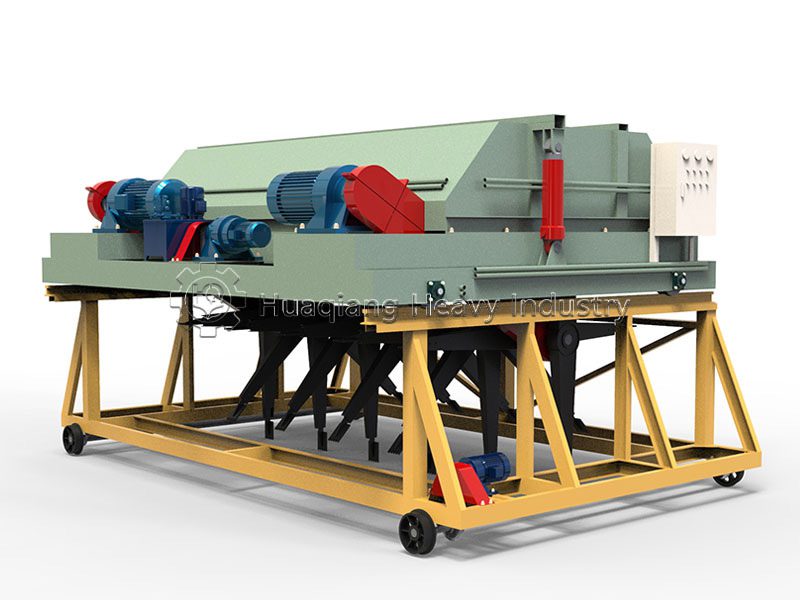
Habit Two: Daily Cleaning to Prevent Drying Drying fermented materials turn them into abrasives, accelerating wear on the blade assembly and housing. At the end of each day’s operation, residual material on the blade rollers, chassis, and hopper must be removed, especially the accumulated material between the chain and scraper. For trough-type compost turners, loose material on the tracks must also be cleaned. If the equipment is to be stored for an extended period, apply rust-preventive oil after cleaning to prevent corrosion of metal parts.
Habit Three: Regularly Calibrate the Turning Mechanism The gap between the turning blade assembly and the housing should be maintained at 3-5mm. Too large a gap will result in incomplete turning, while too small a gap can easily cause jamming and damage. Check the wear of the blade assembly quarterly; when wear exceeds 1/3 of its length, the entire assembly must be replaced. After replacement, a dynamic balancing test must be performed to prevent operational vibration. The parallelism of the track on a trough-type compost turner and the turning depth sensor on a self-propelled machine also require regular calibration.
Habit 4: Check the hydraulic system, prevent leaks and maintain pressure.
The hydraulic system is the “muscle” of the compost turner. Check the oil level daily, maintaining it at 1/2-2/3 of the mark; check the oil quality monthly, replacing it immediately if it emulsifies or changes color; replace the hydraulic oil filter every six months. If oil leaks are found at pipe joints, replace the seals promptly, and tighten to the torque specified in the instruction manual. Pay special attention to the oil temperature of the self-propelled machine’s hydraulic motor; a temperature exceeding 80℃ may indicate overload or poor heat dissipation.
Habit 5: No-load test run, listen for problems.
Before each start-up, run the equipment without load for 2-3 minutes. Listen for any abnormal noises—a sharp whistling sound indicates insufficient bearing lubrication; periodic impact sounds indicate loose cutter groups or a loose chain; a whistling sound from the hydraulic system may indicate a clogged suction filter. Observe the instrument displays during no-load operation to ensure they are normal before feeding materials.
When professional maintenance personnel are unavailable, the “observation, smelling, questioning, and palpation” method can be followed: Observation – Daily inspection of components for looseness or oil leaks; Smell – Smell for any burnt odor in the electrical wiring; Questioning – Record any abnormal operating phenomena; Palpation – Touch the bearing temperature, using 60℃ as the threshold (hold for 3 seconds on the back of your hand). Spare parts inventory recommendations: Keep one set each of chain, cutter head, bearing, and seals. Rubber parts (oil seals, hoses) should be stored away from light to prevent aging.
Addressing the pain point of difficult maintenance for overseas users, our compost turner adopts several maintenance-free designs: the trough-type compost turner‘s track pulleys have built-in self-lubricating bearings, eliminating the need for daily lubrication; the self-propelled equipment’s walking system comes standard with maintenance-free wheel hub bearing units; the hydraulic system uses imported seals, extending their lifespan by 3 times compared to ordinary parts; the compost turner cutter head uses a high-chromium wear-resistant alloy, extending the replacement cycle to 800-1000 hours. All lubrication points are centrally located on the outside of the equipment, allowing a single person to complete the entire lubrication process in 5 minutes.
The detailed maintenance guide for both trough-type and self-propelled compost turners underscores that reliable operation of any fermentation composting technology depends on diligent care. The specific maintenance tasks—track cleaning for a trough-type compost turner versus tire pressure checks for a self-propelled machine—are direct consequences of their distinct designs, yet both are critical applications of fermentation composting turning technology. A large wheel compost turner, for instance, requires specific attention to its massive tires and drive system, while a chain compost turning machine needs regular chain tensioning and lubrication. A windrow composting machine used in open fields has its own set of concerns, such as exposure to the elements. Regardless of the machine—whether it’s a sophisticated trough-type aerobic fermentation composting technology system with its track-guided precision or a simple, flexible trough type composting turner—the five universal habits of regular lubrication, daily cleaning, mechanism calibration, hydraulic system checks, and no-load test runs form the foundation of preventative maintenance. Mastering these habits is the key to maximizing the lifespan and ensuring the consistent performance of any fermentation composting technology investment, especially when professional support is distant.