
In the production of bio-organic fertilizer, the core challenge is not how to fully decompose the material, but how to preserve the activity of functional bacteria during fermentation. Ordinary compost turners rely on high-speed rotating blades to violently agitate the material. While this provides ample oxygen, the intense friction and impact can cause localized temperature spikes, killing many beneficial bacteria unknowingly. Huaqiang Heavy Industry’s double screws compost turner was designed to solve this problem—it employs a double-helix gentle stirring design, ensuring uniform oxygen supply while minimizing mechanical friction, thus becoming a “guardian of microbial strains” in bio-organic fertilizer fermentation. This article will explain the unique advantages and application techniques of this equipment.
Core Advantage: Gentle yet Thorough Mixing Art
Double Helix Blades, Uniform Mixing from Top to Bottom
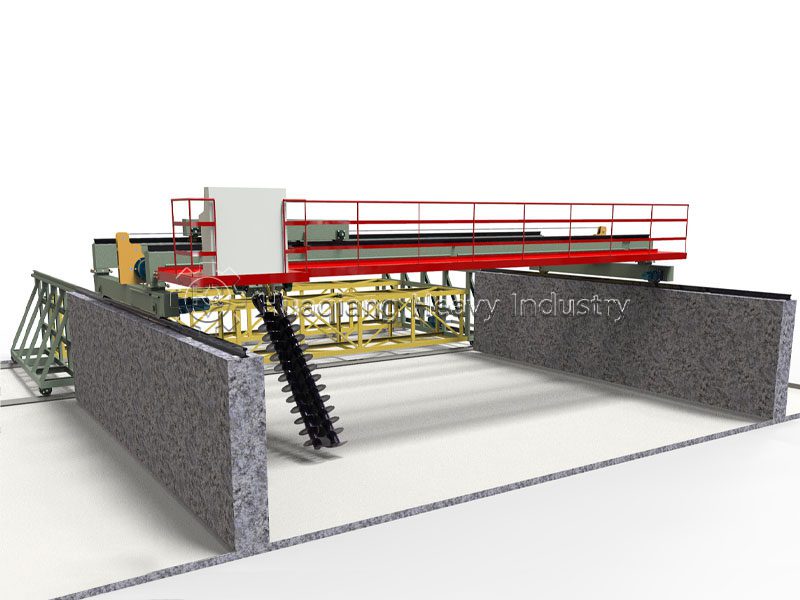
Ordinary compost turners can only turn the material from the bottom to the surface, resulting in limited mixing. Huaqiang’s double screws compost turner uses two opposing rotating helical blades that lift the material from the bottom to the top and push it inwards during rotation, creating three-dimensional mixing. Regardless of the height or width of the material pile, every part of the material can be repeatedly mixed, achieving a fermentation uniformity of over 98%. This design avoids the common problem of “surface fermentation while the interior remains raw.”
Low-Speed Turning, No High-Temperature Friction
The design philosophy of the double-spiral turner is “gentle yet thorough.” The spiral blades operate at a low speed and high torque (typically controlled at 30-60 rpm), far lower than the speed of ordinary turners. The material is gently lifted and turned between the blades, rather than violently impacted. Actual measurements show that the material temperature rise during turning is controlled within 3-5℃, preventing localized overheating due to mechanical friction, creating a safe living environment for functional bacteria.
Increased Aeration, Meeting Aerobic Needs
Although the turning action is gentle, the oxygen supply effect is not compromised at all. While turning the material, the spiral blades create countless micropores within the pile, allowing air to naturally penetrate deep. The bulk density of the turned pile is reduced by 20%-30%, and the aeration is significantly improved, perfectly meeting the oxygen requirements of aerobic bacteria.
Process Adaptation Techniques: Ensuring Microbial Growth in the Optimal Environment
Temperature Control in the “Golden Range” of 55-60℃
The ideal temperature range for bio-organic fertilizer fermentation is 55-60℃. Below 55℃, unwanted microorganisms may proliferate; above 65℃, functional microorganisms begin to die off in large numbers. The gentle turning characteristic of the double-helix turner minimizes temperature fluctuations in the pile, making it easier to maintain within the ideal range. Operators should monitor the center temperature of the pile daily, turning and cooling promptly when it approaches 65℃, and reducing the frequency of turning to maintain warmth when it falls below 50℃.
Turning Every 3 Days to Avoid Frequent Disturbance
While regular organic fertilizer fermentation advocates “frequent and rapid turning,” bio-organic fertilizer is different—frequent turning leads to drastic temperature fluctuations, which negatively impacts microbial activity. Based on extensive practice, turning every 3 days is optimal when using a double-helix turner. This frequency ensures sufficient oxygen supply while maintaining a relatively stable pile temperature, giving functional microorganisms ample time to multiply.
Reduce Turning Depth in Later Stages to Minimize Microbial Loss
In the later stages of fermentation (after 15 days), the material is basically decomposed, and functional bacteria have multiplied and colonized the organic particles. At this time, it is recommended to reduce the turning depth from the original 80-100 cm to 40-50 cm, turning only the surface material to avoid excessive disturbance and loss of deep-layer microorganisms. The hydraulic lifting system of the Huaqiang double-spiral turning machine can easily achieve this adjustment.
III. Key Operating Points: Precise Operation for Greater Efficiency
Check the Spiral Blades Before Start-up
The spiral blades are the core working component. Before each operation, check for looseness, deformation, or entanglement of debris. Especially when processing fibrous materials, remove any straw that may be entangled at the base of the blades to ensure smooth rotation. Huaqiang equipment blades are made of wear-resistant alloy material, with a lifespan of over 2000 hours under normal use.
Maintain a Uniform Speed to Ensure No Dead Angles
During operation, maintain a uniform, straight-line speed of 2-3 meters per minute. Walking too fast will result in insufficient turning depth and uneven mixing; walking too slowly will lead to low efficiency. When turning, the spiral blades should be lifted to avoid excessive force on one side. For the end area of the material pile, an additional round of turning can be added to ensure no dead corners.
Compatible with a fermentation tank for better results
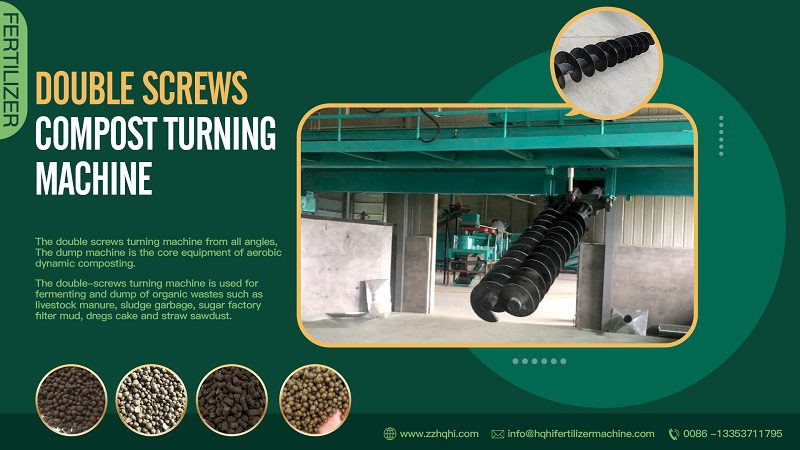
The double-screws turning machine can operate outdoors and is also suitable for constant-temperature fermentation tanks. Fermentation tanks with sheds and covers can avoid interference from rain and snow, and with heating or insulation systems, constant-temperature fermentation can be achieved year-round. Huaqiang Heavy Industry can provide an integrated solution of “double-spiral turning machine + constant-temperature fermentation tank” to further improve the survival rate of microorganisms.
Case Study: Live Bacteria Count Exceeds 200 Million/Gram
A professional bio-organic fertilizer plant had long been troubled by the insufficient live bacteria count in its products—using ordinary turning machines for fermentation, the live bacteria count in the finished product consistently hovered around 50 million/gram, which, although meeting the standard, could not create a premium advantage. After introducing the Huaqiang double-screws turning machine, the factory systematically optimized its fermentation process:
The material pile temperature is stably controlled at 55-60℃, with fluctuations not exceeding 5℃.
The turning frequency is strictly adhered to once every 3 days.
The turning depth is reduced in the later stages of fermentation to protect deeper microbial cultures.
The results of the first batch of finished products were encouraging: the effective viable bacteria count reached 210 million/gram, far exceeding the national standard (20 million/gram) by more than 10 times. Leveraging this quality advantage, the factory’s products successfully entered the high-end cash crop region, commanding a 30% higher price than ordinary products, yet demand still exceeds supply.
Equipment Support: From Single Machine to System Upgrade
For bio-organic fertilizer manufacturers pursuing ultimate quality, Huaqiang Heavy Industry also offers complete solutions:
Constant Temperature Fermentation Tank: Insulated walls + automatic temperature control create the most suitable microenvironment for microbial growth.
Automatic Spraying System: Automatically replenishes water based on the moisture content of the material pile, avoiding uneven distribution due to manual operation.
Intelligent Monitoring System: Real-time monitoring of temperature, humidity, and oxygen concentration, with automatic early warning.
Low-Temperature Drying Equipment: After fermentation, low-temperature drying technology is used to maximize the preservation of microbial activity.
From gentle double-helix mixing to precise process control, and then to intelligent system support—Huaqiang’s double-helix turning machine provides a brand-new “microbial-friendly” solution for bio-organic fertilizer production. When your product’s live bacteria count far exceeds industry standards, and when the high-end market opens its doors to you, you will understand: for bio-organic fertilizer, protecting the microbial strain is protecting the product’s core competitiveness.
The gentle yet thorough action of the double screws compost turning machine represents a significant advancement in fermentation composting turning technology. This equipment is a vital component of the equipments required for biofertilizer production, designed specifically to preserve microbial activity. However, the choice of composting technology depends on scale and production goals. For large-scale outdoor windrows, a large wheel compost turner or windrow composting machine provides efficient aeration. For more controlled, intensive systems, a trough-type compost turner or a robust chain compost turner operates within enclosed spaces, optimizing conditions for microbial growth. Whether using the gentle double-screw design for premium bio-fertilizers or a high-capacity windrow turner for bulk organic production, the selection of the appropriate fermentation composting turning technology is critical for maximizing both decomposition efficiency and, in the case of biofertilizers, the final viable microbial count.