
Introduction:
In today’s agricultural sector, efficient fertilizer handling is as vital as a lifeline, directly impacting crop yields and global food security. With the rapid advancement of technology, various fertilizer equipment have emerged, from mixers and dryers to granulators and packaging machines, collectively weaving a modern production network. In this network, the Bucket Conveyor shines as a bright star, leading the way with its outstanding performance. It not only revolutionizes traditional conveying methods but also excels in enhancing efficiency, saving space, and promoting environmental protection, making it an indispensable smart choice in fertilizer handling.
Main Body:
The advantages of the bucket elevator are multifaceted and worth exploring in depth. First and foremost, its unparalleled spatial adaptability: whether vertically ascending to several meters high or conveying steadily at an incline, it operates effortlessly in confined spaces. Compared to bulky belt conveyor or screw conveyor, the bucket conveyor acts like a space magician, maximizing vertical space through compact design, saving valuable floor space for fertilizer plants, especially in industrial environments with limited area. Secondly, its sealed design serves as a guardian, effectively curbing dust emission and material waste. In fertilizer handling, dust not only pollutes the environment but can also cause health issues; the closed structure of the Bucket Conveyor ensures almost zero leakage during transmission, safeguarding fertilizer purity and maintaining a clean and safe working environment. Additionally, its smooth operation, low noise, and easy maintenance make it a reliable assistant in reducing long-term operational costs. Modern Bucket elevators are made from wear-resistant materials, offering long lifespan and low failure rates, further enhancing economic benefits.
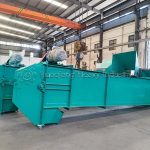
In the symphony of fertilizer equipment, the Bucket elevator does not exist in isolation but harmonizes with other instruments to play a melodious tune of efficient production. For example, partnering with mixers, the Bucket Conveyor precisely delivers raw materials to mixing zones, ensuring uniform blending of fertilizer components; dancing with dryers, it facilitates uninterrupted drying processes, preventing heat loss; linking with granulators, it transports semi-finished products for shaping; and finally, orchestrating with packaging machines, it propels the production line towards full automation, seamlessly completing the journey from raw materials to finished products. This synergy makes the entire handling process flow like a symphony, significantly boosting productivity while reducing manual intervention and error rates.
It is worth noting that other fertilizer equipment are also evolving. For instance, intelligent mixers use sensors to monitor blending ratios in real-time, dryers employ energy-saving technologies to reduce consumption, and packaging machines integrate the Internet of Things (IoT) for remote control. However, as the “blood vessels” connecting these devices, the Bucket Conveyor’s efficient transmission capability is key to the smooth operation of the entire system. Without it, even the most advanced equipment may suffer from reduced efficiency due to material blockages or delays.
Conclusion:
In summary, with its trio of strengths—efficiency, space-saving, and eco-friendliness—the Bucket elevator has become the core engine in fertilizer handling. Facing the wave of agricultural modernization, it will continue to ride the tides, integrating with IoT and artificial intelligence for smarter monitoring and optimization. From family farms to large fertilizer plants, the Bucket Conveyor, with its practicality and innovation, injects continuous momentum into green agriculture, helping turn the dream of global sustainable agriculture into reality.