
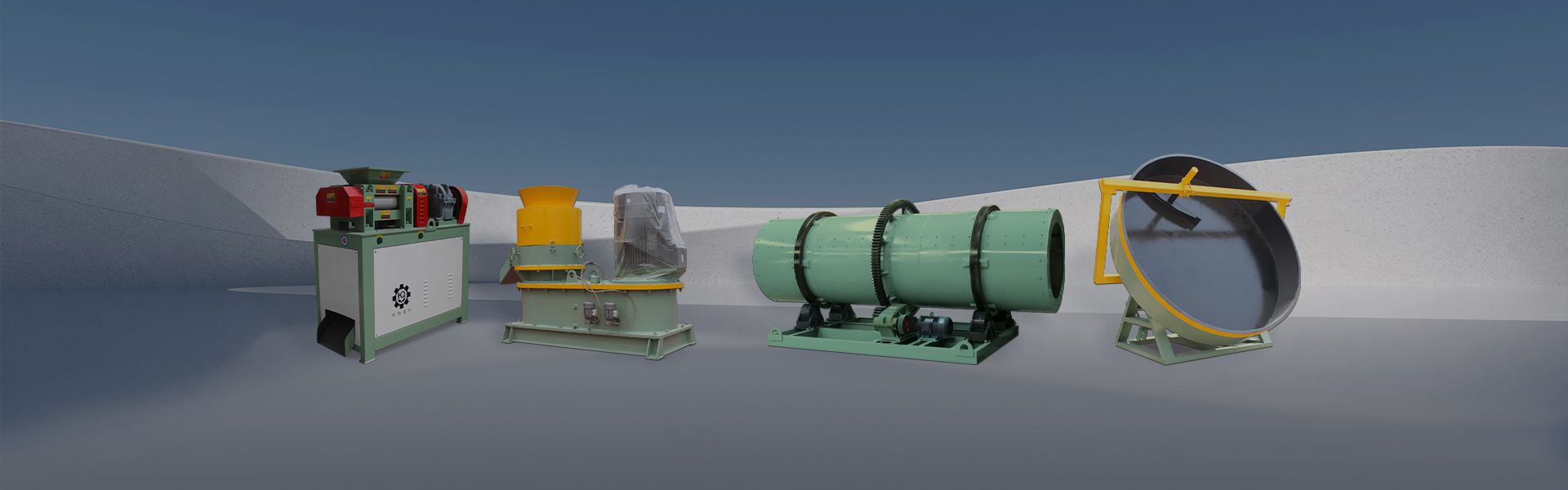
If you had to name a “granulation master” on an organic fertilizer production line, the rotary drum granulator would undoubtedly be the one. Today, let’s step into its installation site and see what makes this master so special.
The site is buzzing with activity. An orange-red drum, over seven meters long and two meters in diameter, already lies on its base like a giant train carriage. Several installers are busy around it: one uses a feeler gauge to check the contact between the riding ring and the support rollers, another adjusts the radial runout of the large gear with a laser alignment tool, while a third tightens the last row of bolts on the rubber liner inside the drum. A technician lies flat on the ground, his eye glued to a level, murmuring, “Raise the front support roller another two millimeters—good, stop!” Every fine adjustment is made to ensure the equipment runs as steadily as a clock.
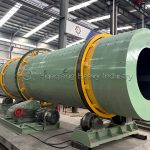
Why is the rotary drum granulator so popular? Because it has an almost magical ability. Fermented organic material is wet and sticky—left to sun-dry or simple mixing, it will never form pellets. But once it enters the drum, as the cylinder rotates slowly, the material, under the combined forces of centrifugal force, friction, and binders, rolls like snowballs into ever-rounder shapes. Even better, the operator can easily control pellet size and hardness by adjusting rotation speed, inclination angle, and steam flow. No wonder veteran workers say, “As soon as the drum turns, you know what you’ll get.”
Of course, a complete production line can’t rely on the granulator alone. Behind it, a half-wet material crusher has already been connected to power, its feed opening gaping wide, ready to bite lumpy raw materials into fine powder. Next to it stands a rotary screener machine, with workers using spirit levels to level the base—a tilt of even a fraction would send pellets back to the reject pile by mistake. The cooler sits right beside the screener, its outer shell wrapped in insulation, ready to rapidly cool down hot, freshly formed pellets so they don’t clump together. Conveyor belts stretch like several gray dragons, winding all the way from the crushing area to the packaging area, stringing these steel giants into a rhythmic whole.
At three in the afternoon, the last sensor is installed. The commissioning engineer presses the start button. The drum accelerates from stillness, emitting a low, deep hum that gradually becomes steady and powerful. Someone dumps a shovel of mixed feed into the inlet. Two minutes later, uniform, round pellets tumble out of the discharge port. Everyone crowds around to pick them up—smooth surfaces, firm to the squeeze, and when dropped on the ground, they bounce twice. Laughter and applause break out. Who says organic fertilizer granulation has to rely on extrusion? This rotary drum granulator, with its simple yet brilliant “rolling philosophy,” turns sticky, wet raw materials into golden hope.
As the sun sets, the entire production line stands in silence, like an orchestra waiting to play. And the rotary drum granulator is the most steady drummer of all—never rushing, never flustered, turning round after round, and making every pellet perfectly round.