
In the resource utilization of livestock farm manure, chicken and cow manure are the most common and also the most challenging raw materials—they have a moisture content as high as 60%-80%, are prone to caking and putrefaction, and frequently clog ordinary equipment, making complete fermentation difficult. How to overcome this challenge? The key lies in tailoring a dedicated equipment solution for high-moisture raw materials. This article will break down the entire process from solid-liquid separation to finished product packaging, helping you turn manure into a valuable resource, relieving environmental pressure and creating economic benefits.
Step One: Solid-Liquid Separation—Squeezing Out the Water The first hurdle in processing high-moisture raw materials is dehydration. Fresh chicken and cow manure have too high a moisture content; direct fermentation not only has a long cycle but also produces a large amount of foul odor. Dehydration must first be performed using a screw extrusion solid-liquid separator.
This equipment uses high-pressure extrusion from the screw shaft to quickly separate the free water from the manure. The separated solid portion has a moisture content reduced to 50%-60%, laying a good foundation for subsequent fermentation. The separated liquid is rich in nutrients and can be directly used in a biogas digester to generate energy, or further processed for use as liquid fertilizer, maximizing resource utilization. For example, a farm processing 20 tons of cow manure per day can meet its initial dehydration needs with a separator producing 3-5 tons per hour.
Second Step: Fermentation and Composting – Making the Material Pile “Alive” Although the dehydrated raw material has reduced its moisture content, it is still considered high-moisture material (50%-60% moisture content). Ordinary compost turners face high resistance and are prone to jamming. At this point, a hydraulic compost turner is needed – a “dedicated tool” for fermenting high-moisture raw materials.
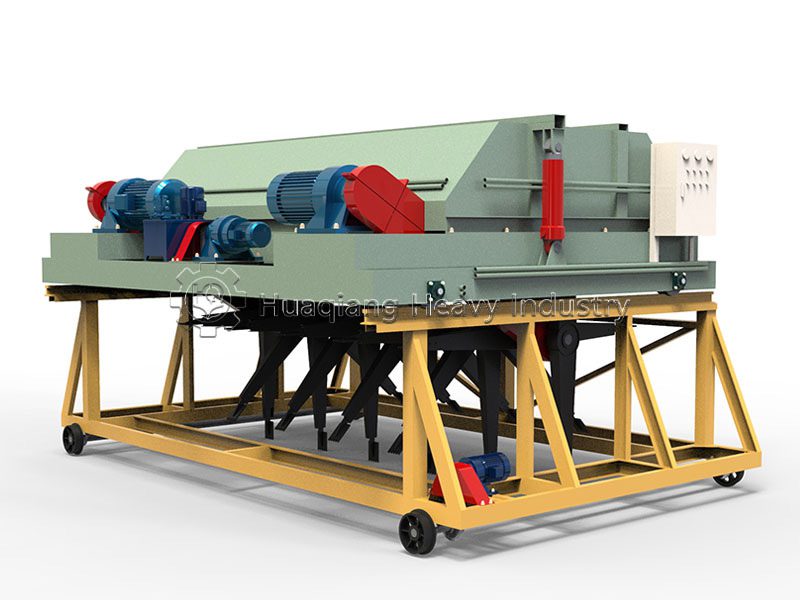
The hydraulic compost turner is hydraulically driven, providing strong power. Its turning torque is more than 30% higher than that of a motor of the same power, easily handling high-moisture, compacted material piles. Its turning blades have a crushing function, breaking up clumps while turning the material, significantly improving the pile’s aeration. During operation, it is recommended to adjust the turning blade to its maximum depth (80-100 cm) and control the walking speed at a slow setting of 1-2 meters per minute to ensure thorough turning.
Simultaneously, pulverized straw, rice husks, and other auxiliary materials should be mixed in according to the specified ratio (chicken manure:straw ≈ 3:1, cow manure:straw ≈ 2:1), adjusting the carbon-nitrogen ratio to the ideal range of 25:1-30:1. This not only improves air permeability but also effectively avoids fermentation odors. Under the powerful operation of the hydraulic turning machine, high-moisture piles can be fully decomposed in 15-20 days, shortening the process by more than 10 days compared to traditional methods.
III. Third Step: Crushing and Refining – Preparing “Raw Materials” for Granulation Although the decomposed material is stable, it often clumps together and must be crushed before entering the granulation stage. Ordinary crushers are prone to clogging when dealing with high-moisture materials; therefore, a semi-wet material crusher is required.
This equipment is specifically designed for composted materials with a moisture content of 25%-55%. It employs a two-stage rotor structure and a screenless design, where the material is torn into fine particles through high-speed collision and friction within the machine, preventing clogging. The output fineness can be controlled between 20-40 mesh, which is the ideal working range for a disc granulator. The pulverized material is loose and uniform, requiring no secondary processing before being directly fed into the granulator.
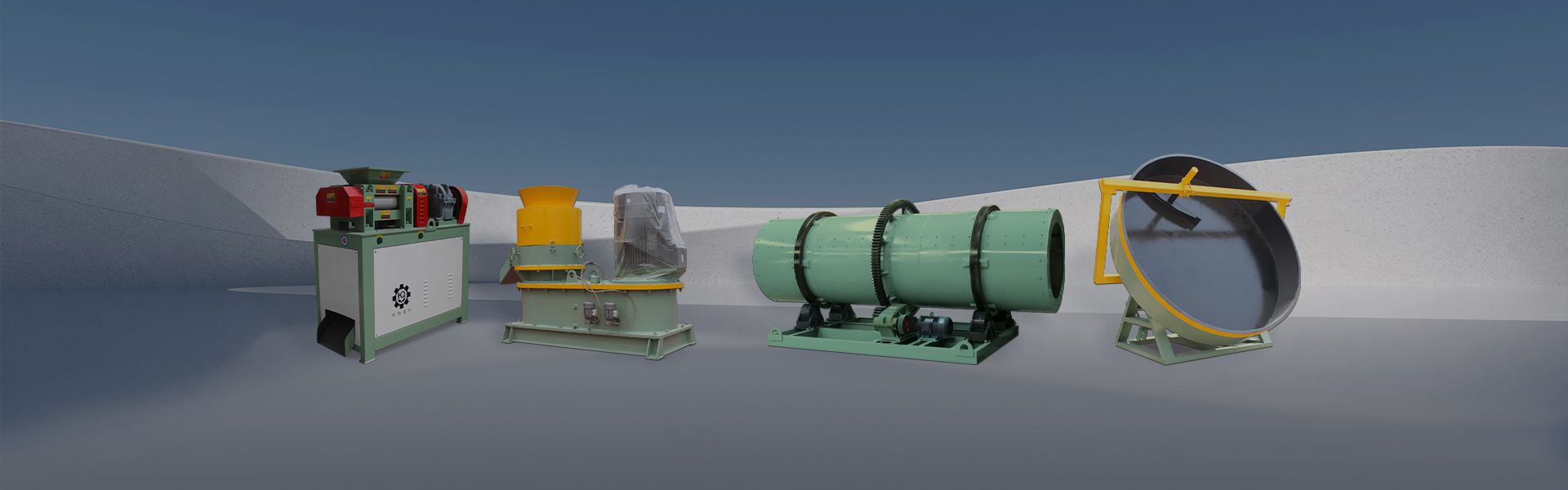
Step Four: Granulation and Packaging – From “Soil Fertilizer” to “Commercial Product” The best choice for pure organic fertilizer granulation is a disc granulator. It utilizes the material’s own viscosity, causing it to roll into spheres under the centrifugal force and friction of the rotating disc. No chemical binders are needed, and the finished product has an organic matter content close to 100%.
During operation, the disc tilt angle (35°-55°), rotation speed (10-20 rpm), and water spray volume can be adjusted according to the target particle diameter. Under suitable parameters, the forming rate can reach over 95%, and the particle diameter is adjustable from 2-8 mm. Wet granules can be spread out to dry for 1-2 days in sunny weather to reduce moisture content to a safe storage standard (below 15%), eliminating the need for further drying and saving significant energy. The dried granules are then graded by a vibrating screen. Qualified granules are bagged in a packaging machine, while oversized granules or fine powder are returned to the granulator for reuse, achieving zero raw material waste.
Solution Advantages: Full-Process Adaptability to High-Moisture Raw Materials
The greatest value of this four-step solution lies in its “full-process adaptability to high-moisture raw materials”—from dehydration to fermentation, from crushing to granulation, every piece of equipment is designed to overcome the challenges of high moisture content, ensuring smooth operation and minimizing frequent manual intervention. Livestock farms can achieve on-site treatment and utilization of manure, alleviating the pressure of environmental inspections and transforming waste into high-value-added commercial organic fertilizer.
From the initial solid-liquid separation process to the final bag sealing in the packaging machine, every step in the production of organic fertilizer from high-moisture raw materials requires precisely matched equipment support. Huaqiang Heavy Industry’s specialized equipment covers the entire process and can tailor a complete solution for you from farm to fertilizer plant, truly turning high-moisture manure into “treasure”.
Specialized Composting Turners for High-Moisture Manure
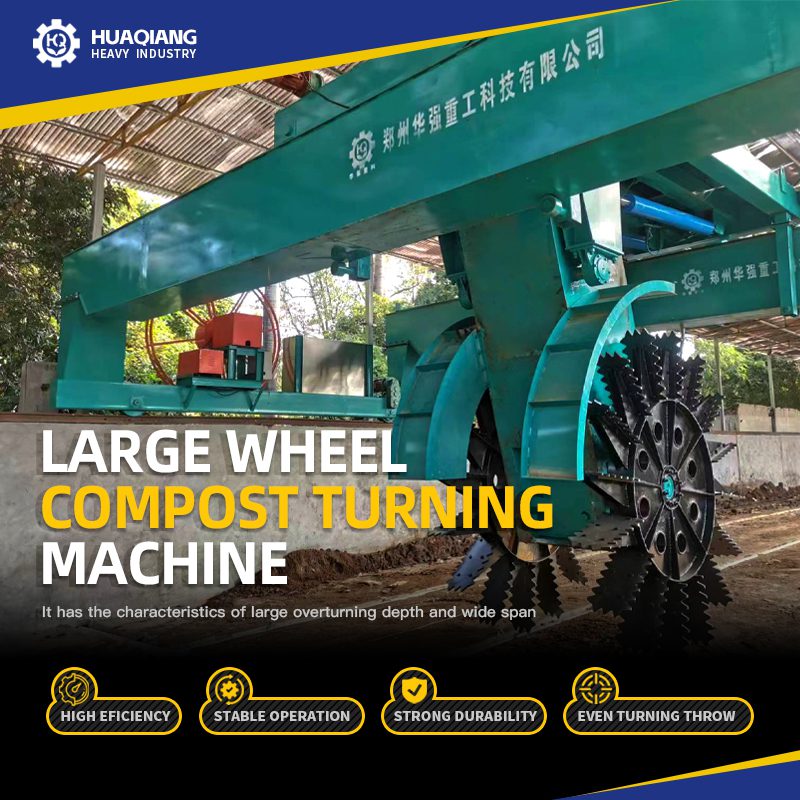
While the hydraulic turner is a powerful tool for high-moisture materials, a range of other specialized fertilizer raw material processing machinery and equipment exists to handle different scales and configurations. For very large, open-air windrow operations, a large wheel compost turner provides efficient aeration across wide piles. A windrow composting machine (often tractor-towed) offers a flexible, mobile solution for farms with varying pile locations. For more controlled, intensive processing, a trough-type compost turner operates within concrete channels. Within such a system, a chain compost turner provides a robust turning mechanism, ideal for heavier materials. An alternative within troughs is the double screws compost turning machine, which, like its hydraulic counterpart, is designed for gentle but thorough mixing, preserving pile structure while ensuring aeration. The selection among these—from the high-torque hydraulic turner to the versatile chain compost turner—depends on the specific raw material characteristics, available space, and desired processing intensity, ensuring efficient decomposition even for the most challenging high-moisture manures.