
In organic fertilizer production, fermentation turning technology is a core element determining the speed of composting and product quality. Uniform turning ensures sufficient oxygen supply, controllable temperature, rapid composting, and no off-odors; improper turning easily leads to anaerobic zones, prolonged fermentation cycles, and nutrient loss. This article analyzes the core technical principles and modern optimization paths of fermentation turning, providing professional reference for technology decision-makers.
The Core Technology of Fermentation Turning: Oxygen Supply, Temperature Control, and Homogenization
Aerobic microorganisms are the driving force behind organic fertilizer fermentation. Their life activities require sufficient oxygen, suitable temperature, and a homogeneous material environment. The core value of turning technology revolves around these three needs: breaking up the compacted material layer through mechanical action, allowing oxygen to fully enter the pile—studies show that turning can increase the oxygen volume fraction in the pile to 18.5%. Simultaneously, turning promptly removes carbon dioxide and water vapor produced during fermentation, regulating the pile temperature and preventing localized overheating (>70℃) that could kill beneficial bacteria. Furthermore, turning ensures uniform mixing of surface and bottom materials, guaranteeing that each part of the material undergoes a complete high-temperature composting process.
From manual turning to intelligent mechanized operations, turning technology has undergone multiple iterations. Current development exhibits three major trends: Intelligent – real-time monitoring of pile temperature and oxygen content via sensors to automatically adjust turning frequency and depth; Automated – programmable control of equipment to achieve fixed-point, timed, and quantitative turning; Environmentally friendly – closed fermentation combined with a waste gas collection system to control odor emissions at the source. Modern turning equipment is no longer a simple material handling tool, but an intelligent operating unit integrating sensors, control algorithms, and mechanical optimization.
The core of trough-type closed turning lies in oxygen content control. Fixed fermentation troughs combined with track-mounted equipment can precisely control the turning depth (up to 1.6m) and frequency. Key technical points include: The use of an odd-even quadruple helix rake design ensures balanced axial force and stable operation, reducing unit energy consumption by 11.4% compared to traditional designs; combined with a bottom aeration system, it achieves coordinated operation of forced ventilation and mechanical turning, preventing rapid oxygen depletion after turning—research shows that oxygen in the pile is depleted within 27 minutes after turning.
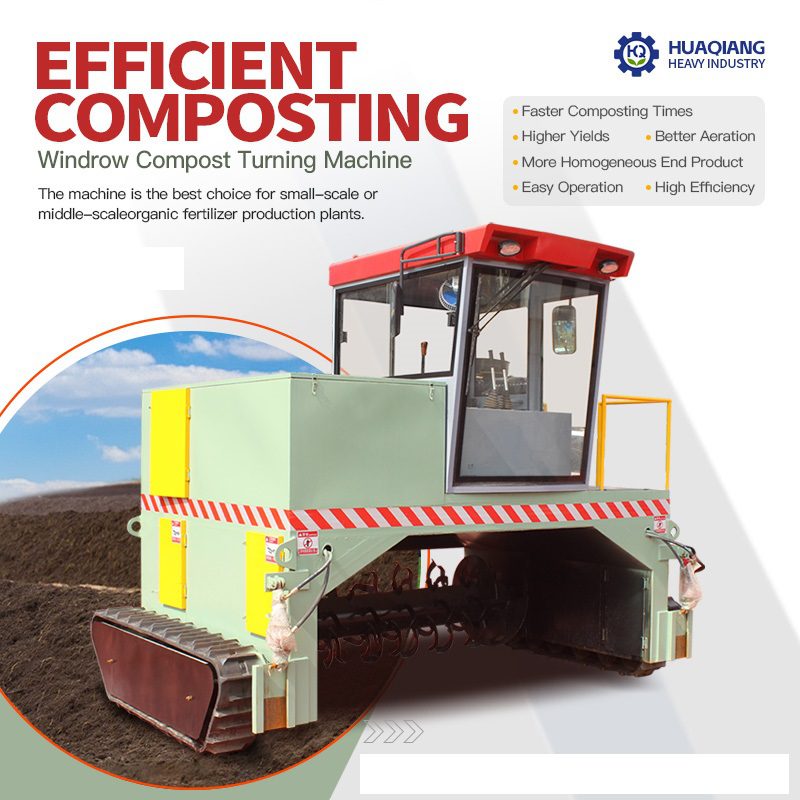
The key technical point of open-air windrow turning lies in controlling the pile thickness. The material stack height needs to be controlled between 1.5-2.0m; too thick and the bottom will be compacted and oxygen-deficient, too thin and heat will dissipate too quickly. The turning frequency needs to be dynamically adjusted according to the fermentation stage—turning every 2-3 days during the high-temperature period (55-65℃), and extending to 5-7 days during the cooling period. A study in Egypt showed that the optimal turning effect was achieved using a self-propelled turning machine with a forward speed of 1500m/h, a rotor linear speed of 240rpm, and a pile height of 100cm.
The scientific setting of the turning frequency is the core of efficiency optimization. Increasing the frequency of turning the compost pile helps raise the material temperature and degrade organic matter, resulting in more thorough inactivation of pathogens. However, excessive turning can lead to heat loss and prolong the fermentation cycle. Generally, it is recommended to turn the pile every 2 days in the early stage (0-10 days), every 3-4 days in the middle stage (10-20 days), and once a week in the later stage (20-30 days).
The turning speed needs to be adjusted according to the characteristics of the material. When processing raw materials with high moisture content, the speed should be appropriately reduced to prevent material splashing; when processing high-fiber raw materials, the speed should be increased to enhance the cutting effect. Modern equipment often uses variable frequency speed control, which can automatically adjust the speed according to the material load, achieving on-demand energy supply.
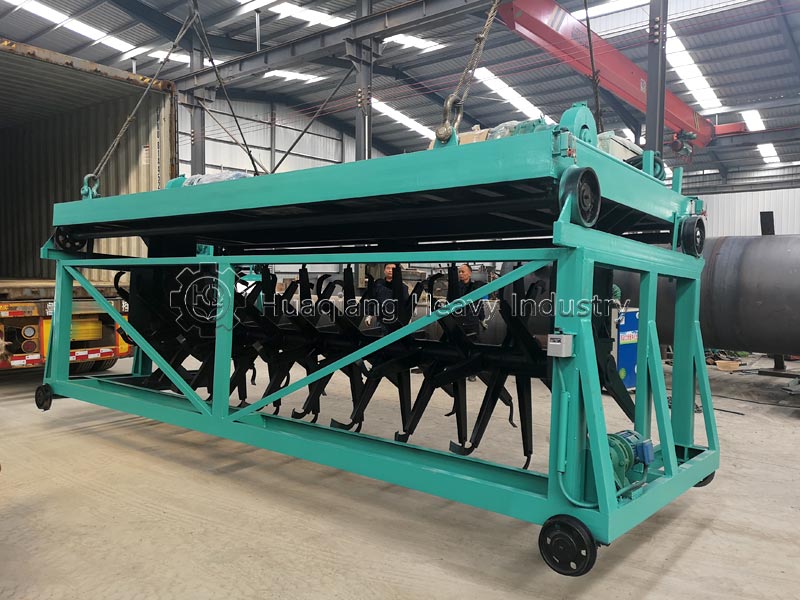
Our company’s turning equipment integrates several core technologies: an intelligent variable frequency turning system that monitors the pile temperature and load in real time and automatically adjusts the turning frequency and travel speed; a precise oxygen control design that stabilizes the oxygen content within the suitable range of 12%-18% through coordinated turning and aeration; and a hydraulic lifting device that can dynamically adjust the turning depth (0.8-1.8m) to adapt to the needs of different fermentation stages. The equipment can be equipped with a remote monitoring module, allowing operators to check the operating status and adjust operational parameters via their mobile phones.
From closed troughs to open windrows, from manual control to intelligent operation, every advancement in fermentation and turning technology has propelled organic fertilizer production towards greater efficiency and environmental friendliness. Understanding the technical principles and mastering optimization techniques are essential for unleashing equipment efficiency and achieving high-quality organic fertilizer production.
The detailed analysis of turning principles underscores the evolution of fermentation composting technology from a manual art to a precise science. Today, fermentation composting turning technology encompasses a diverse range of equipment, each optimized for specific systems. For large-scale, open-air operations, a large wheel compost turner is the powerhouse, efficiently processing massive windrows. A more flexible, tractor-towed windrow composting machine offers an adaptable solution for smaller or variable sites. For applications demanding maximum process control and environmental containment, trough-type aerobic fermentation composting technology is the preferred approach. This system relies on a dedicated trough-type compost turner that moves along fixed rails within concrete channels, ensuring precise, repeatable turning and enabling effective exhaust gas collection. A robust chain compost turner, known for its durable lifting action, is also a common choice for such trough systems. The selection among these technologies—from the massive reach of a large wheel compost turner to the controlled precision of a trough-type compost turner—represents a strategic decision that aligns the inherent principles of aerobic decomposition with the specific demands of scale, environmental regulation, and desired product consistency. Mastering fermentation composting technology today means understanding not just the biology, but also the optimal application of this sophisticated machinery.