
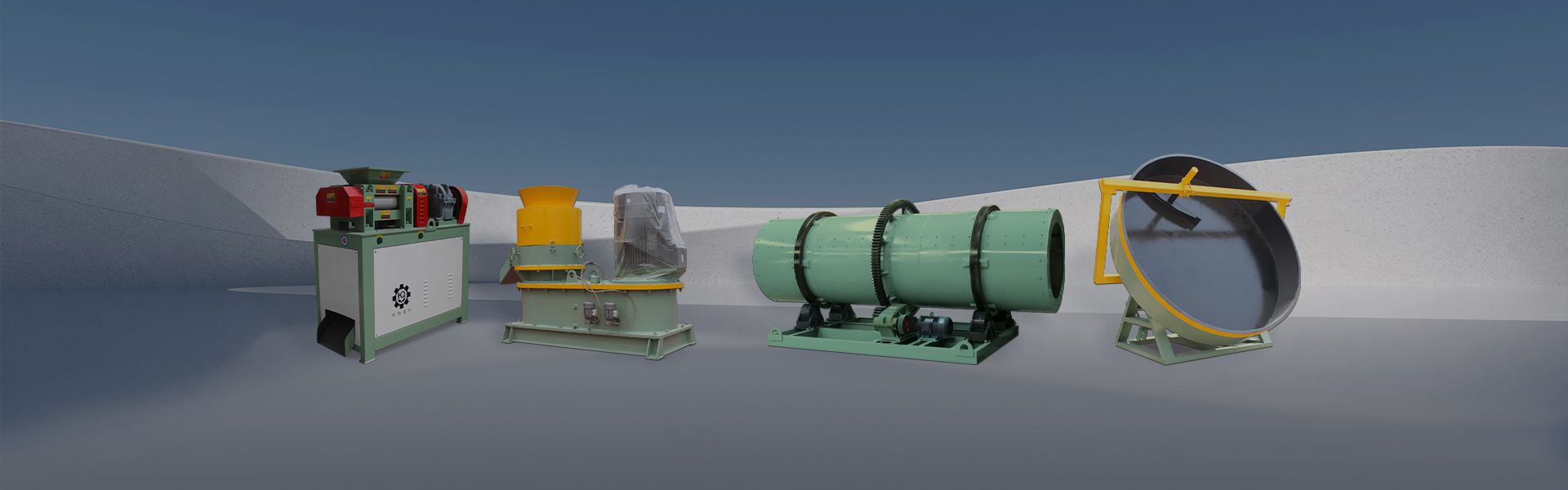
In the fields of organic fertilizer and feed pelletizing, where production scale, raw material characteristics, and investment costs must be balanced, the Flat Die Pellet Mill stands out as the preferred forming equipment for many producers due to its rugged durability, strong adaptability, and ease of maintenance. Like a steady and reliable “pressure sculptor,” it transforms powdered materials directly into high-density pellets through mechanical extrusion, offering a turnkey pelletizing solution for small to medium-scale production lines.
Core Advantages: Simple Yet Powerful Structure, Specializing in Fibrous Materials
The core of the flat die pellet machine lies in its horizontally positioned die plate and vertically rotating press rollers. During operation, material is subjected to immense pressure between the rollers and the flat die, forced through the die holes to form strands, which are then cut into pellets by knives. This working principle delivers three outstanding advantages:
Powerful Compression Capability: Especially suitable for processing organic materials with high fiber content and low viscosity, such as straw powder, sawdust, and mushroom residue, which are challenging for other pelletizing methods.
Simple Structure, Easy Maintenance: Compared to the more complex ring die pellet mill, the flat die mill is easier to disassemble and clean. Die and roller replacement is more straightforward, significantly reducing downtime and maintenance costs.
Flexible Moisture Requirement: Materials only need a relatively low moisture content (typically 15%-20%) to form, reducing the energy demand for pre-drying.
Key Differentiation from Ring Die Pellet Mills
Although both flat die and ring die mills belong to the extrusion type, their positioning differs significantly:
Flat Die Mill: The die is positioned horizontally, relying on vertical pressure for extrusion. It is more suited for small to medium output, organic-based raw materials, and laboratory or farm-scale production. Its structure is more compact with a lower investment threshold.
Ring Die Machine: The die is a vertical ring, with rollers applying radial pressure from the inside. It is designed for large-scale, continuous production, particularly dominant in the feed and compound fertilizer industries when paired with sophisticated conditioning systems. However, equipment cost and maintenance complexity are higher.
Therefore, the flat die mill is not merely a “simplified version” of the ring die mill but a specialized choice with comparative advantages in specific application scenarios, such as organic waste recycling.
Technical Focus: The Art of Die and Adjustment
The key to forming quality lies in the die (hole size and shape) and the precise adjustment of the roller gap. Different dies can produce cylindrical pellets ranging from 2 to 12 mm in diameter. Advanced flat die mills are equipped with hydraulic or spring pressure systems, allowing flexible adaptation to the forming pressure requirements of different raw materials and ensuring smooth operation.
Application Scenarios: Wide Adaptability from Farm to Factory
Whether it’s a family farm processing its own livestock manure and straw, a small organic fertilizer plant producing commercial pelletized fertilizer, or a biomass fuel plant manufacturing fuel pellets, the flat die pellet mill provides a reliable and economical forming solution. It serves as a critical bridge connecting dispersed organic waste with standardized commercial pellets.
Conclusion: Irreplaceable in Its Niche
Amidst the industrial trend pursuing large-scale, fully automated production, the flat die pellet mill firmly holds its niche in the small to medium-scale organic material forming sector with its unique mechanical principle, excellent material adaptability, and outstanding cost-effectiveness. It proves that specialization and practicality often solve real production problems more effectively than mere scale expansion. Choosing a flat die pellet mill means opting for a more pragmatic, focused, and sustainable path to pelletization.