
If you’re new to the organic fertilizer production industry and feeling overwhelmed by the wide variety of compost turning equipment on the market, this article is for you. Whether you’re a small farmer, a startup owner, or an agricultural waste management professional, mastering the basics of compost turning equipment is the first step towards successful fermentation.
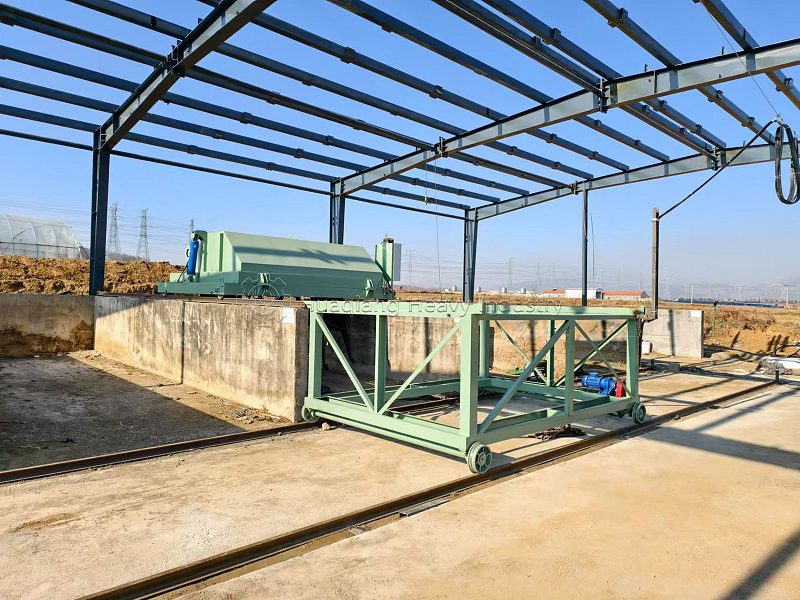
Compost turning equipment can be mainly divided into five categories based on its structure and operation method. Large wheeled compost turners resemble giant vehicles straddling fertilizer piles, moving via large-diameter wheels and rotating blades that turn the material from bottom to top, suitable for large-scale open-air composting. Chain-mounted compost turners use chains to drive the blades; these compact and flexible machines can operate directly on muddy or concrete surfaces, making them a cost-effective choice for small to medium-scale production. Trench compost turners travel back and forth along fixed tracks within fermentation troughs and can be used with roofs and exhaust gas collection systems to achieve closed, environmentally friendly fermentation. Self-propelled compost turners have their own power and walking system, allowing them to move freely between different stacks; one machine can cover hundreds of acres of fermentation area. Winding pile turning equipment is a general term for various turning machines specifically designed for open-air windrow fermentation. Their core task is to pile materials into standard windrows and turn them regularly.
Simplified Explanation of the Principle: What exactly does turning do?
Regardless of the type of equipment, the core principle of turning can be summarized in three actions: breaking up compaction—during fermentation, materials are compacted to form a hard shell; the turning blades break this up, allowing oxygen to re-enter the pile; uniform mixing—exchanging the positions of the surface and bottom layers, and the edges and center, ensuring that each part undergoes the same high-temperature fermentation process; and regulating temperature and humidity—turning dissipates heat and moisture, preventing the pile temperature from becoming too high and killing beneficial bacteria, while also removing excess moisture.
Mastering the “four-step method” is key to starting turning operations. The first step is a pre-start inspection—confirm that all bolts are tight, clean debris around the blades and the walking system, and run the machine unloaded for 2-3 minutes to listen for any abnormal noises. The second step is parameter adjustment—set the turning depth according to the material type (generally 0.8-1.5 meters); for self-propelled equipment, the walking speed also needs to be adjusted. The third step is to set the turning frequency—turn every 2 days in the early fermentation stage (0-10 days), every 3-4 days in the middle stage (10-20 days), and once a week in the later stage (20-30 days). The fourth step is cleaning after shutdown—be sure to remove any residual material from the blade assembly and chassis to prevent jamming upon restarting.
Misconception 1: The higher the turning frequency, the better. Excessive turning leads to heat loss and prolongs the fermentation cycle. Follow the principle of “frequent turning during high-temperature periods and less turning during cooling periods.” Misconception 2: Neglecting raw material moisture control. Overly wet materials easily clump together, while overly dry materials slow fermentation. The ideal moisture content is 55%-65%, judged by the feel: “can be squeezed into a ball but crumbles when dropped.” Misconception 3: Not cleaning the equipment regularly. Residual material, once dried, becomes as hard as cement, accelerating blade wear and even causing the equipment to jam.
For beginners, I recommend chain-plate type turning machines and small self-propelled turning machines. Both types of equipment are simple to operate and maintain, with a low investment threshold—equipment with a capacity of 20-30 cubic meters per hour requires an investment of only US$10,000 to US$30,000. The equipment comes standard with an easy-to-understand English control panel, and key components such as chains and cutters feature a modular design, requiring no special tools for replacement. For beginners with limited space, a trough-type compost turner combined with single-trough fermentation requires only 100-200 square meters of space, making it a safe choice for initial setup.
Starting from scratch, choosing the right equipment, mastering the principles, and operating according to regulations will ensure a more stable and sustainable path for your organic fertilizer production.
For beginners, the diverse world of compost turners can be distilled into a few key choices, each representing a different implementation of fermentation composting turning technology. A large wheel compost turner is the powerful workhorse for large-scale, open-air windrow operations. For smaller, more flexible setups, a chain compost turner or a windrow composting machine offers an economical and versatile entry point. For those with limited space or facing strict environmental regulations, a trough type composting turner operating within a fixed channel provides a controlled, enclosed option. All of these machines function as an agriculture waste compost fermentation machine, each applying the core principles of aeration, mixing, and temperature control. The beginner’s “four-step method”—pre-start inspection, parameter adjustment, frequency setting, and post-shutdown cleaning—is universal. Whether you are operating a massive large wheel compost turner on a large farm or a compact chain compost turner for a small startup, these fundamental practices are the key to successful fermentation composting turning technology. Starting with the right machine for your scale and mastering these basics will transform the complex process of composting into a manageable and rewarding pathway to producing high-quality organic fertilizer.