
Introduction: Challenges and Opportunities in Vertical Conveying
In modern fertilizer production and processing, space optimization has become a key factor determining production efficiency. When factory height is sufficient but floor space is limited, how can materials be vertically conveyed efficiently? The bucket conveyor, with its unique design philosophy, provides an elegant and efficient solution to this challenge. It is not just a conveying device but a space magician, transforming vertical dimensions into productivity advantages.
Four Core Advantages of Bucket Conveyors
Exceptional space utilization is the most striking feature of bucket conveyor. Unlike traditional horizontal conveying equipment, they fully utilize vertical space, occupying only 30% of the floor area of equipment with equivalent processing capacity. This design philosophy of “claiming space upward” brings valuable operating areas to crowded production lines.
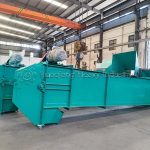
Efficient vertical conveying capability is equally impressive. Bucket conveyors are specifically designed for vertical or steep-angle conveying, able to lift materials to required heights with minimal energy consumption. Their enclosed design reduces dust generation and material loss, maintaining material integrity during lifting.
Wide material adaptability makes them versatile players in fertilizer handling. Whether granular chemical fertilizers, powdered organic fertilizers, or moist compost, bucket conveyors can handle them steadily. The unique bucket design ensures materials are less likely to spill during conveying, particularly suitable for handling dust-prone materials.
Energy-saving and environmentally friendly design aligns with modern industrial green trends. Compared to pneumatic conveying systems, bucket conveyors reduce energy consumption by over 40%; compared to multi-equipment conveying solutions, they reduce equipment count and maintenance points, lowering overall operational costs.
Comprehensive Comparison with Other Fertilizer Conveying Equipment
Belt Conveyor Horizontal
Suitable for long-distance horizontal conveying but limited in vertical lifting capability. When direction changes are needed, multiple units are typically required, increasing complexity and cost. Compared to bucket conveyors, they occupy more floor space with lower space utilization.
Screw Conveyor Short-distance
Suitable for short-distance conveying but sensitive to material characteristics, prone to particle breakage. Vertical conveying efficiency is low, energy consumption high, and maintenance complex. For fertilizer handling scenarios requiring vertical lifting, screw conveyors often fall short.
Pneumatic Conveying System Long-distance
Suitable for long-distance conveying but extremely energy-intensive, complex equipment, and high maintenance costs. Strict requirements on material dryness, not suitable for moist organic fertilizers. Dust control is also a significant challenge.
Drag Chain Conveyor Specific Materials
Suitable for specific materials but noisy, energy-intensive, and requires frequent maintenance. Vertical conveying capability is limited, and materials suffer some degree of breakage, potentially affecting fertilizer quality.
Bucket conveyors stand out among these equipment types because they are specifically optimized for vertical conveying scenarios, achieving an excellent balance in space utilization, energy efficiency, and material adaptability.
Five Reasons to Choose Bucket Conveyors
Maximize Space Value: Fully utilize vertical space, freeing up valuable floor area for production, especially suitable for production environments with sufficient factory height but crowded floors
Reduce Comprehensive Costs: A single unit completes vertical lifting tasks, avoiding the complexity and high costs of multi-equipment combinations, with a short investment return period
Protect Material Integrity: Gentle conveying reduces fertilizer particle breakage, maintaining material physical properties and chemical stability
Enhance Environmental Friendliness: Enclosed design effectively controls dust dispersion, reduces environmental pollution, and improves working conditions
Increase System Reliability: Simple structure, easy maintenance, stable operation, low failure rate, ensuring production process continuity
Conclusion: The Future Choice for Vertical Conveying
With its unique design philosophy and exceptional performance, bucket conveyors are redefining standards for vertical conveying in fertilizer handling. They not only solve space limitation challenges but also, with efficient energy utilization and reliable operation, become core components of modern fertilizer production lines. In today’s context of increasingly scarce land resources and ever-increasing production efficiency requirements, choosing bucket conveyors is not just a technical decision but a strategic investment in future production models. As technology continues to advance, bucket conveyors will continue to play a key role in fertilizer handling, driving the entire industry toward more efficient and environmentally friendly development.