
In today’s rapidly developing green agriculture, organic fertilizers have become a new favorite in agricultural production due to their ability to improve soil structure and enhance crop quality. However, the compost turner, a core piece of equipment in the organic fertilizer production process, is rarely known to the general public. It’s like a silently working “behind-the-scenes hero,” transforming agricultural and forestry waste, livestock manure, and other organic raw materials into a nutritious “feast” for the soil through scientific turning and mixing operations.
The core function of a compost turner is to create optimal conditions for the fermentation of organic materials. For organic waste to be transformed into qualified organic fertilizer, it must undergo a high-temperature aerobic fermentation stage, a process that requires sufficient oxygen, suitable temperature, and humidity. The compost turner, through mechanical turning, moves deep-layer materials to the surface and mixes dry surface materials into the deeper layers, achieving uniform mixing. This operation not only provides sufficient oxygen for microbial activity but also effectively regulates the pile temperature, preventing localized overheating or cooling that could affect the fermentation process. This ensures that harmful substances are fully decomposed at high temperatures, guaranteeing the safety and effectiveness of the organic fertilizer.
There are many types of compost turners on the market to suit different production needs. Simple compost turners have a simple structure and are easy to operate, suitable for small-scale production scenarios such as small farms and family farms, with low investment costs and simple maintenance; hydraulic compost turners, with their hydraulic drive system, have stronger power output, deeper turning depth, and higher operating efficiency, suitable for medium-sized organic fertilizer production enterprises; double-helix compost turners use a unique double-helix structure, providing extremely uniform turning and effectively reducing material clumping, especially suitable for processing high-moisture, high-viscosity organic raw materials.
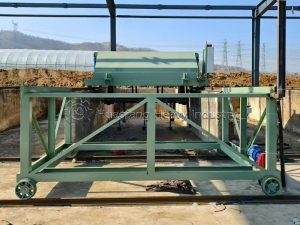
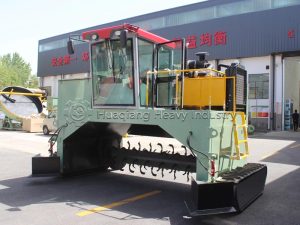
In addition to the common types mentioned above, there are also windrow, chain, and large-wheel type compost turners. Windrow composting turners can operate in open fields without the need for complex fermentation tanks, offering high flexibility; chain-type composting turners use chain drives for turning, making them highly adaptable to various materials and capable of processing all types of organic waste; large-wheeled composting turners, with their extra-large wheel diameter and large ground contact area, are suitable for operation on soft ground, preventing equipment from sinking. Different types of composting turners have their own advantages, and users can make reasonable choices based on production scale, material characteristics, and site conditions.
The application of composting turners not only promotes the development of the organic fertilizer industry but also plays a crucial role in environmental protection. Traditional methods of organic waste treatment often involve open-air stacking or landfilling, which not only occupies a large amount of land resources but also generates foul-smelling gases and pollutes soil, water, and air. Through processing with composting turners, organic waste can be efficiently converted into organic fertilizer, achieving resource recycling and reducing environmental pollution. According to statistics, a medium-sized composting turner can process thousands of tons of organic waste annually, equivalent to reducing hundreds of tons of pollutant emissions, making a significant contribution to ecological environmental protection.
With the in-depth promotion of the concept of green agricultural development, the market demand for organic fertilizers will continue to grow, and the technical level of composting turners, as key equipment in organic fertilizer production, will also continuously improve. In the future, composting turners will develop towards intelligence, high efficiency, and environmental friendliness. By integrating advanced technologies such as the Internet of Things and big data, they will achieve remote monitoring, automatic adjustment, and intelligent operation and maintenance, further improving production efficiency and product quality. At the same time, energy consumption will be continuously reduced, and environmental performance will be continuously optimized, providing stronger support for sustainable agricultural development.
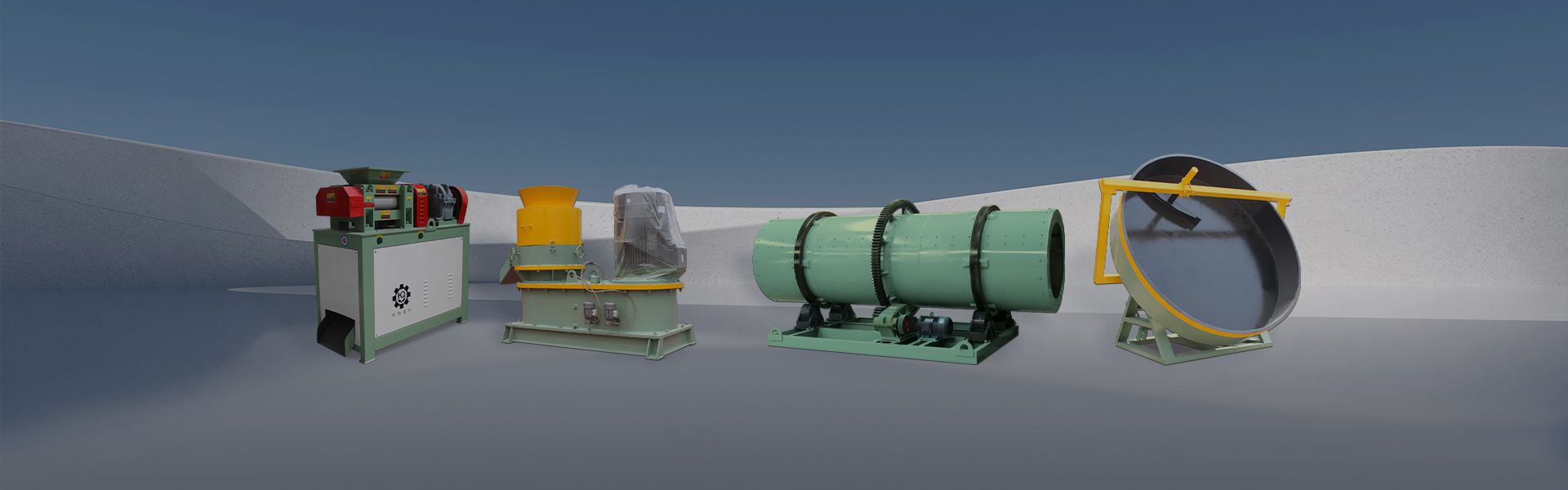
The selection of a compost turner is a critical decision within the broader fermentation composting technology for organic fertilizer. For large-scale open-air operations, a large wheel compost turner is highly effective for windrows. For more controlled and intensive processing, trough-type aerobic fermentation composting technology is employed, utilizing specialized equipment like a trough-type compost turner or a chain compost turning machine that moves along a concrete channel. These machines are the core of modern fermentation composting turning technology and are essential equipments required for biofertilizer production, collectively serving as a high-efficiency agriculture waste compost fermentation machine. Following complete fermentation, the cured compost can be shaped into granules. While drum granulation is a common method for this stage, the entire process—from turning to granulation—forms an integrated system that efficiently transforms raw organic waste into stable, valuable biofertilizer.