



Equipment Introduction
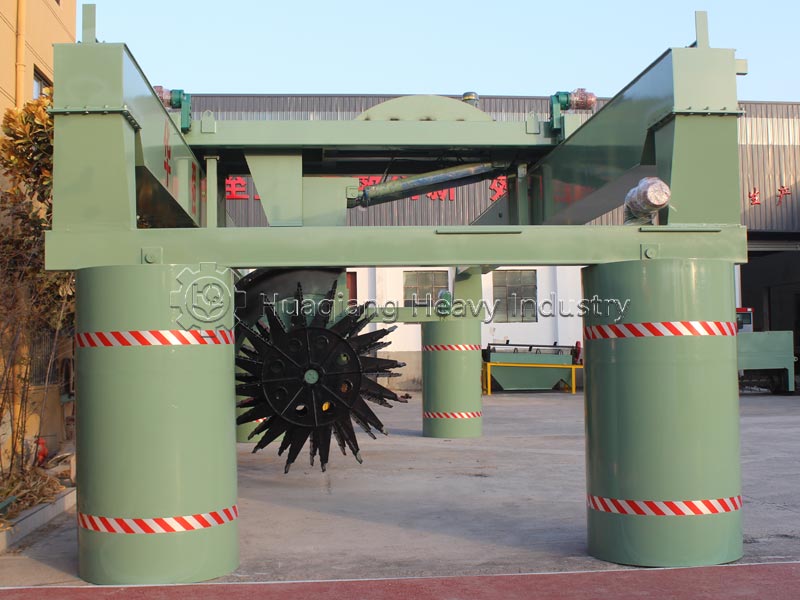
The large wheel compost turner, also known as a disc-type compost turner, impeller compost turner, or wheel-type compost turner, is a large-scale, fixed compost turning device specifically designed for aerobic fermentation in troughs. The entire machine spans the fermentation trough and moves back and forth along tracks on both sides of the trough via wheels. Equipped with a high-power motor drive system and a hydraulic lifting system, it can turn materials to a depth of 1.5–3 meters and a width of 12–30 meters, making it a core fermentation equipment in large and medium-sized organic fertilizer production lines. Its core function is to deeply turn, oxygenate, crush, and mix the materials in the trough during organic material fermentation, achieving efficient aerobic fermentation. This equipment is mainly used for aerobic fermentation turning operations of organic waste such as livestock and poultry manure, sludge, sugar mill filter mud, pomace, and straw sawdust. The equipment adopts a unique energy-saving and efficient transmission structure and is equipped with a fully automated electrical control system, which can reduce energy consumption by 70% compared to traditional organic fertilizer turning equipment for the same workload. Large disc compost turners do not have high requirements for fermentation methods and are more adaptable than trough-type compost turners (which require the construction of fermentation troughs) and mobile compost turners (which require the material to be piled into windrows). The equipment can be widely used in fermentation, composting, and moisture removal operations in organic fertilizer plants, compound fertilizer plants, sludge and waste plants, horticultural farms, and button mushroom cultivation plants.
Equipment Structure
1. Transmission/Power System (Power Transmission Device)
Components: Electric motor—Reducer—Bearing housing—Main shaft (Power Link)
Function: Provides rotational power to the turner. The motor output, after reduction, drives the main shaft and turner.
2. Walking System (Walking Device/Turning Walking)
Components: Walking motor, transmission gears, walking wheels, etc.
Function: Enables the turner to move along the track on the fermentation tank, covering the entire tank.
3. Hydraulic Lifting System (Hydraulic Lifting Device)
Components: Hydraulic pump station, solenoid valve body, hydraulic oil pipes, hydraulic cylinder (column), etc.
Function: Achieves adjustment and raising/lowering of the turner’s height above the ground (prevents it from hitting the ground and ensures effective turning). 4. Turning Device (Wheeler + Turning Plate/Rake Teeth)
Composition: Whirler, manganese steel toothed turning plate (or rake tooth mechanism), turning motor + reducer
Mechanism of Operation (key points from your diagram): When the whirler is running, it lifts the material in the trough from the bottom to the top of the pile; and moves the material approximately 3–5 m (distance given in the diagram) after turning it to stir it;
This achieves fast turning speed, uniform stirring, and promotes full contact between the material and oxygen, improving the aerobic fermentation effect.
5. Control and Safety System
Centralized Control Cabinet: Manual/Automatic Control
Limit Switches: Exceedance Protection/Limit Protection
Grounding and Electrical Protection: Ensures operational safety (your diagram emphasizes track grounding, motor grounding, etc.)
Equipment Applications
The large wheel compost turner has a wide range of applications, suitable for aerobic fermentation treatment of various organic wastes:
1. Organic Fertilizer Production:
Fermentation and turning of livestock and poultry manure (pig manure, cow manure, chicken manure, sheep manure, etc.)
Fermentation and composting operations in organic fertilizer plants and compound fertilizer plants
2. Agricultural Waste Treatment:
Fermentation treatment of crop straw and straw sawdust
Industrial organic waste such as sugar factory filter mud, lees, and cake residue
Mushroom residue, distiller’s grains, garden dead branches and leaves, agricultural waste residue, etc.
3. Urban Organic Solid Waste Treatment:
Aerobic composting of urban sludge and sludge waste
Fermentation treatment of domestic waste
4. Other Fields:
Fermentation, composting, and moisture removal operations in horticultural farms and button mushroom cultivation plants
Bioremediation of contaminated soil
This equipment is suitable for aerobic fermentation and can be used in conjunction with solar fermentation chambers, fermentation tanks, and transfer machines. When used with a transfer machine, it can achieve multi-tank functionality.
Applicable Raw Materials
The large wheel compost turner can process a wide variety of raw materials, mainly including:
1. Livestock and Poultry Manure: Pig manure, cow manure, chicken manure, sheep manure, and other types of livestock and poultry manure. Whether it’s highly moist and viscous fermentation material or loose fibrous materials, it can achieve thorough turning and breaking up without dead angles.
2. Agricultural Waste: Various crop straws, straw sawdust, garden branches and fallen leaves, etc.
3. Industrial Organic Waste: Sugar factory filter mud, residue cake, mushroom residue, distiller’s grains, etc.
4. Urban Organic Waste: Urban sludge, sludge garbage, etc.
The suitable moisture content for raw material fermentation is around 55%. The equipment has excellent adaptability to material moisture content and bulkiness.
Working Principle of the Equipment
The large wheel compost turner operates on the basis of aerobic fermentation technology. The core mechanism is as follows:
I. Power Transmission Principle: The electric motor directly transmits power to the reducer, which is connected to the main shaft of the compost turner. The disc is fixed by coupling flanges at both ends of the shaft. The transmission system consists of the motor, main shaft, and embedded hardened gear sets with variable-direction arc gears, providing strong power to the compost turner.
II. Turning and Turning Operation Principle
1. Longitudinal Movement: The entire machine moves longitudinally along the tracks on both sides of the fermentation tank, with an adjustable speed (1–15 m/min).
2. Lateral Movement: The turning trolley drives the wheel to move left and right in the width of the tank, achieving full coverage and no dead angles during turning and turning.
3. Wheel Cutting: The wheel rotates at high speed (20–40 r/min), and the equipped double-stage 4-layer spatial three-dimensional structure blades perform stepped progressive cutting of the material.
4. Lifting and Throwing: The material in the fermentation tank is lifted from the bottom of the tank to the surface of the pile, and then turned, stirred, and moved to a position 3–5 meters away.
5. Aeration and Oxygen Supply: During the turning and turning process, the material has full and large-area contact with air, quickly replenishing the oxygen inside the pile.
III. Aerobic Fermentation Principle
Through regular turning and turning, the pile temperature rises rapidly to 50–65℃. Under this high-temperature condition:
1. Pathogens, insect eggs, and weed seeds are effectively killed.
2. Microorganisms fully decompose organic matter.
3. The fermentation cycle is shortened.
4. 5. Maintain the oxygen content of the compost pile within the ideal range.
Avoid problems such as odor and seedling burn caused by anaerobic fermentation.
Common Equipment Problems and Solutions
1. Common Equipment Problems
| Fault Classification | Fault Phenomenon | Possible Causes |
|---|---|---|
| Compost Turning System Fault | Short turning distance | Severe deformation of rake teeth and shaft or winding of foreign matter; foreign matter jammed on transmission gear or gear damage |
| Wheel disc rubbing the ground | Improper adjustment of wheel disc height; excessive ground level error | |
| Uneven compost turning | Improper wheel disc rotating speed; mismatched traveling speed | |
| Blades scraping ground | Too low set height of wheel disc from ground; uneven ground surface | |
| Traveling System Fault | Unstable traveling | Foreign matter inside traveling gear or transmission device |
| Reducer abnormal noise or overheating | Insufficient lubricating oil; worn bearings; foreign matter jammed in | |
| Abnormal operation of big trolley / small trolley | Uneven track; motor failure; damaged transmission gear | |
| Electrical System Fault | Difficult or failed motor startup with buzzing sound | Excessively worn or damaged bearings; deformed & bent reduction shaft; too low or too high voltage |
| Failure of electric control system | Damaged contactor; short circuit of circuit; faulty limit switch | |
| Soft starter failure | Improper parameter setting; excessive load | |
| Hydraulic System Fault | Inflexible lifting of wheel disc | Insufficient hydraulic oil; solenoid valve failure; aging of hydraulic cylinder seal |
| Loud noise of hydraulic pump station | Blocked oil suction filter screen; worn oil pump; air mixed into oil circuit |
2. Solutions to Equipment Problems
| Fault Classification | Fault Phenomenon | Solutions |
|---|---|---|
| Compost Turning System Fault | Short turning distance | Repair rake teeth or shaft; remove foreign matter; clear foreign matter on transmission gear or replace gears |
| Wheel disc rubbing the ground | Adjust the bolt angle of wheel disc; recalibrate the ground clearance height of wheel disc | |
| Uneven compost turning | Adjust wheel disc rotation speed and traveling speed to matching state | |
| Blades scraping ground | Lift the compost turner in time; inspect and correct ground flatness | |
| Traveling System Fault | Unstable traveling | Clear foreign matter inside traveling gear or transmission device |
| Reducer noise / overheating | Add lubricating oil; check the wear condition of bearings | |
| Abnormal operation of big trolley / small trolley | Check track flatness; overhaul motors and transmission gears | |
| Electrical System Fault | Difficult motor startup | Replace bearings; calibrate or replace reduction shaft; restart after voltage returns to normal |
| Failure of electric control system | Replace damaged contactors; overhaul circuits; replace limit switches | |
| Soft starter failure | Reset parameters; check load conditions | |
| Hydraulic System Fault | Inflexible lifting of wheel disc | Supplement hydraulic oil; overhaul solenoid valve; replace hydraulic cylinder sealing parts |
| Loud noise of hydraulic pump station | Clean oil suction filter screen; overhaul or replace oil pump; remove air in pipeline |
Operating Procedures and Maintenance Methods
I. Operating Procedures:
1. Pre-run Inspection: Check the reducer and lubrication points for oil level, power supply voltage (rated 380V, fluctuation range ±10%), wiring reliability, bolt tightness, and material accumulation height.
2. Start-up Sequence: Start power → Move the trolley to the designated position → Lower the wheel disc → Start the main motor (wheel disc rotates) → Move the trolley into operation.
3. Shutdown Sequence: Stop the trolley → Stop the trolley → Stop the main motor → Hydraulically lift the wheel disc → Disconnect the power.
II. Maintenance Methods:
1. Post-shift Maintenance: Clean residue, add lubricating oil, and disconnect the power.
2. Weekly/Regular Maintenance: Check the gearbox gear oil (replace after the first 200 hours, then annually thereafter), bearing wear, and the integrity of the electrical control cabinet contactors.
Application of Equipment in Production Lines
The large wheel compost turner is the core fermentation equipment in an organic fertilizer production line. In a complete organic fertilizer production line, this equipment is located at the front-end fermentation stage of the process.
1. Typical Organic Fertilizer Production Line Process Flow:
Raw Material Pretreatment (Ingredient Mixing) → Fermentation Turning (Disc Compost Turner) → Crushing → Mixing → Granulation → Drying → Cooling → Screening → Packaging
2. Specific Working Process:
1) Fermentation Material Preparation: Organic waste (such as straw, animal manure, etc.) is mixed in proportion to form a fermentation material suitable for microbial growth.
2) Turning Fermentation: The disc compost turner periodically turns the material, increasing the permeability of the raw materials, accelerating high-temperature composting, and removing odors.
3) Composting and Discharge: After further composting and dehydration, the fermented material is screened to obtain powdered finished organic fertilizer. Disc compost turners can be configured for small production lines with an annual output of 10,000–20,000 tons to medium-sized production lines with an annual output of 50,000–100,000 tons. For large production lines with an annual output of over 100,000 tons, a continuous daily processing capacity of 800–1,500 tons can be achieved through multi-stack cyclic operation.
Fermentation Process of the Equipment
1. Aerobic Fermentation Process Flow
Raw Material Pretreatment: Mix livestock and poultry manure with straw powder and other auxiliary materials in a certain proportion, adjust the moisture content to 50-65%, and the C/N ratio to about 25:1.
Inoculation with Microorganisms: Add a special organic fertilizer fermentation agent.
Pile Construction and Feeding: Feed the mixture into the fermentation tank using a loader, with a pile height of 1.5-3 meters.
Turning and Fermentation: Use a large disc turner to turn the pile regularly, generally every 2-3 days.
Temperature Monitoring: The pile temperature rises to 50-65℃ and is maintained, with the high-temperature period lasting 5-7 days.
Transfer and Push: Each time the pile is turned, it is pushed forward a certain distance, gradually moving from the feeding end to the discharge end.
Post-Ripe Aging: After the temperature drops below 40℃, the aging stage begins.
Discharge: The fully decomposed material reaches the end of the fermentation tank and is discharged by a loader to enter the next process.
2. Key Control Parameters for Fermentation
| Parameter | Control Range | Regulation Method |
|---|---|---|
| Carbon-Nitrogen Ratio (C/N) | Around 25:1 | Adjust by adding straw, rice husk, etc. |
| Moisture Content | 50%–65% | Adjust by adding dry materials or spraying water |
| Ventilation Oxygen Content | 8%–18% | Controlled by compost turning frequency |
| Fermentation Temperature | 50–65℃ | Adjust by heat dissipation via turning or heat preservation |
| pH Value | 6–9 | Adjust by adding lime or acidic materials |
| Compost Turning Frequency | Once every 2–3 days | Adjust according to temperature and material condition |
| Turning Depth | 1.5–3 meters | Adjust wheel disc height through hydraulic system |
3. Fermentation Cycle
High-Temperature Fermentation Period: 7–10 days (temperature 50–65℃)
Transfer Fermentation Period: Material is gradually moved from the feed end to the discharge end
Post-Ripe Aging Period: 7–10 days
Total Fermentation Cycle: Typically 15–30 days, depending on tank length and turning frequency
Equipment Parameters
| Model | Main Motor | Small Car Travel Motor | Big Car Travel Motor | Hydraulic Pump Motor |
|---|---|---|---|---|
| LP-10m | 55KW | 1.5KW×4 | 1.5KW×2(4) | 4KW |
| LP-12m | ||||
| LP-15m | ||||
| LP-20m |
Advantages of the Equipment
Compared to traditional trough-type compost turners, the large wheel compost turning machine offers the following advantages:
1. Larger Turning Depth: The turning depth can reach 2.6 meters, meaning a larger material load per unit area and saving factory floor space.
2. Wide Span: A single machine can span 24-30 meters, suitable for ultra-large fermentation tanks.
3. Low Energy Consumption: Utilizing a unique disc structure, the turning resistance is lower, resulting in lower energy consumption compared to traditional compost turners for the same workload.
4. No Dead Corners: With the trolley’s lateral movement, turning can be achieved without dead corners throughout the entire fermentation tank.
As a core piece of equipment in the fermentation section of large and medium-sized organic fertilizer production lines, the large wheel compost turner, with its advantages of large span, deep depth, high automation, and low energy consumption, has become the preferred fermentation equipment for large-scale organic fertilizer plants, large-scale livestock farms, and sludge treatment centers. Its ground-trough aerobic fermentation technology can convert organic raw materials such as livestock manure and agricultural waste into high-quality organic fertilizer within 15-30 days, achieving the dual goals of resource utilization and environmental protection.
During selection and use, users should choose the appropriate model based on the actual fermentation tank size, raw material quantity, site conditions, and budget, and strictly adhere to operating procedures and maintenance requirements to ensure safe, efficient, and long-term stable operation of the equipment. The large-disc compost turner features a reasonable design structure, high efficiency, low energy consumption, high degree of automation, ease of use, low cost, and wide application, making it a popular and efficient machine.
If you have any questions about fertilizer production equipment, fermentation equipment, production processes, granulation processes, fermentation processes, or would like to learn more about customized solutions, please contact us immediately. Whether it’s equipment selection and pricing, installation, commissioning and operation training, or later maintenance and process upgrades, we can provide you with professional and timely answers and support, offering you a full-process service.