
In organic fertilizer production, fermentation and turning are the core steps in transforming livestock manure, straw, and other waste into stable, mature materials. This process relies on the metabolic activities of aerobic microorganisms, and through the mechanical action of turning equipment, it achieves synergistic control of oxygen supply, temperature control, deodorization, and maturation. Mastering the key technical points of fermentation and turning can shorten the traditional 60-90 day natural composting cycle to 7-15 days, while producing odorless, harmless, and highly mature high-quality organic fertilizer raw materials.
The Four Core Elements of Aerobic Fermentation
The essence of aerobic fermentation is to create the optimal living environment for microorganisms. Oxygen supply is the primary condition—the turning equipment turns the material from the bottom to the surface, allowing oxygen to fully enter the pile and maintain the activity of aerobic bacteria. Temperature control is achieved by dissipating heat through turning, stabilizing the pile temperature within a high-temperature range of 55-75℃. This temperature can quickly kill pathogens and weed seeds without killing beneficial microorganisms. Odor control stems from sufficient oxygen supply—anaerobic environments are the source of malodorous gases such as ammonia and hydrogen sulfide; thorough turning and turning can fundamentally suppress odor production. Maturity is achieved through precise control of the fermentation cycle. Maturity is complete when the pile temperature naturally decreases, there is no odor, and the C/N ratio drops to 20-25:1.
Turning Frequency, Pile Thickness, and Temperature Control: The turning frequency needs to be dynamically adjusted according to the fermentation stage. During the heating phase (0-3 days), turn every 2 days to promote uniform heating; during the high-temperature phase (55-75℃), turn every 1-2 days to prevent localized overheating; during the cooling phase, turn every 3-5 days to reduce heat loss. A pile thickness of 1.2-1.8 meters is recommended; too thick a pile leads to bottom compaction and oxygen deficiency, while too thin a pile results in poor insulation. Temperature is a direct indicator of fermentation progress; below 55℃, oxygen supply or C/N ratio needs to be checked; above 75℃, the pile should be turned and cooled immediately.
Carbon-to-Nitrogen Ratio, Moisture, and Microbial Agent Usage
The carbon-to-nitrogen ratio (C/N) is an indicator of microbial nutrient balance, with an ideal range of 25-30:1. High-nitrogen raw materials (chicken manure) require the addition of high-carbon auxiliary materials such as straw and rice husks; high-carbon raw materials (straw) require the addition of livestock and poultry manure. The initial moisture content of the material should be controlled at 55%-65%, feeling like it “can be clumped together by hand but crumbles when dropped.” If the moisture content is too high, dry materials need to be added; if it is too low, water should be sprayed to adjust. The addition of exogenous microbial agents can accelerate the fermentation process; spraying 0.5-1 kg evenly per ton of raw material can significantly shorten the heating time.
7-15 Day Rapid Composting Process
Achieving rapid composting requires following the principle of “high temperature, short time.” Use trough-type or windrow-type turning equipment, combined with a forced ventilation system, to adjust the material’s C/N ratio to 25-30:1, moisture content to 55%-65%, and pile height to 1.2-1.5 meters. During the high-temperature period, maintain a temperature of 65-70℃ for 5-7 days, turning the material every 24 hours. During the cooling period, allow natural ventilation and turn the material every 3 days. The entire process takes approximately 10-15 days, after which the material reaches the decomposition standard.
From the frequency of turning to temperature and humidity control, from the carbon-nitrogen ratio balance to the addition of microbial agents, every detail of the fermentation turning technology is crucial to decomposition efficiency and product quality. Mastering this technical system will make your organic fertilizer production faster, more stable, and odorless.
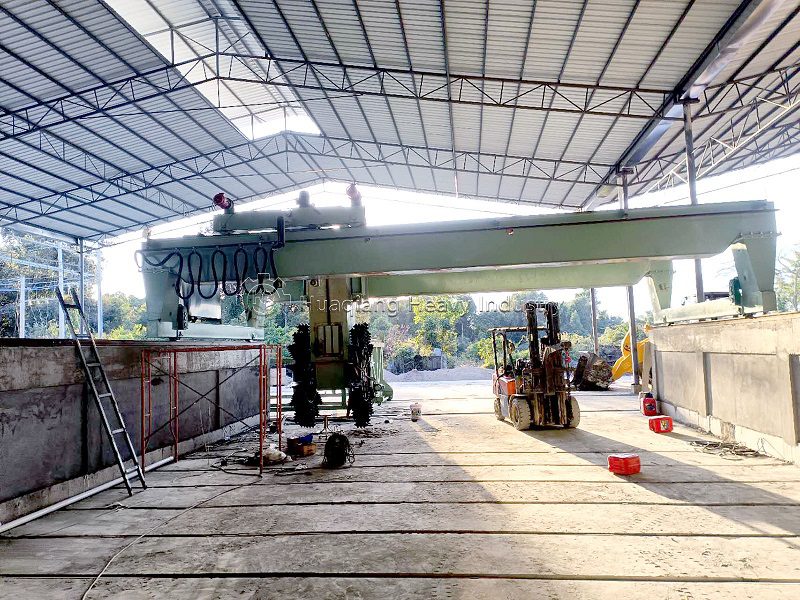
The core elements of aerobic fermentation—oxygen supply, temperature control, deodorization, and maturity—are all managed through the application of fermentation composting turning technology. The organic fertilizer fermentation process relies on specialized equipment to create the optimal environment for microorganisms. For large-scale, open-air windrow operations, a large wheel compost turner or windrow composting machine provides flexible and powerful aeration. For more controlled, intensive processing, trough-type aerobic fermentation composting technology is the industry standard, utilizing a trough-type compost turner or a robust chain compost turner that moves along fixed rails within concrete channels. These machines function as a highly efficient agriculture waste compost fermentation machine. The choice between a windrow composting machine for open-air flexibility and a trough-type compost turner for controlled, high-efficiency production depends on the specific scale, site constraints, and environmental regulations. Mastering the interplay between these technologies and the four core elements of fermentation—from precise C/N ratio and moisture control to the critical turning frequency—is the key to achieving the 7-15 day rapid composting cycle. This systematic approach to fermentation composting turning technology ensures that the agriculture waste compost fermentation machine operates at peak efficiency, transforming raw waste into a stable, mature, and odorless organic fertilizer base.