
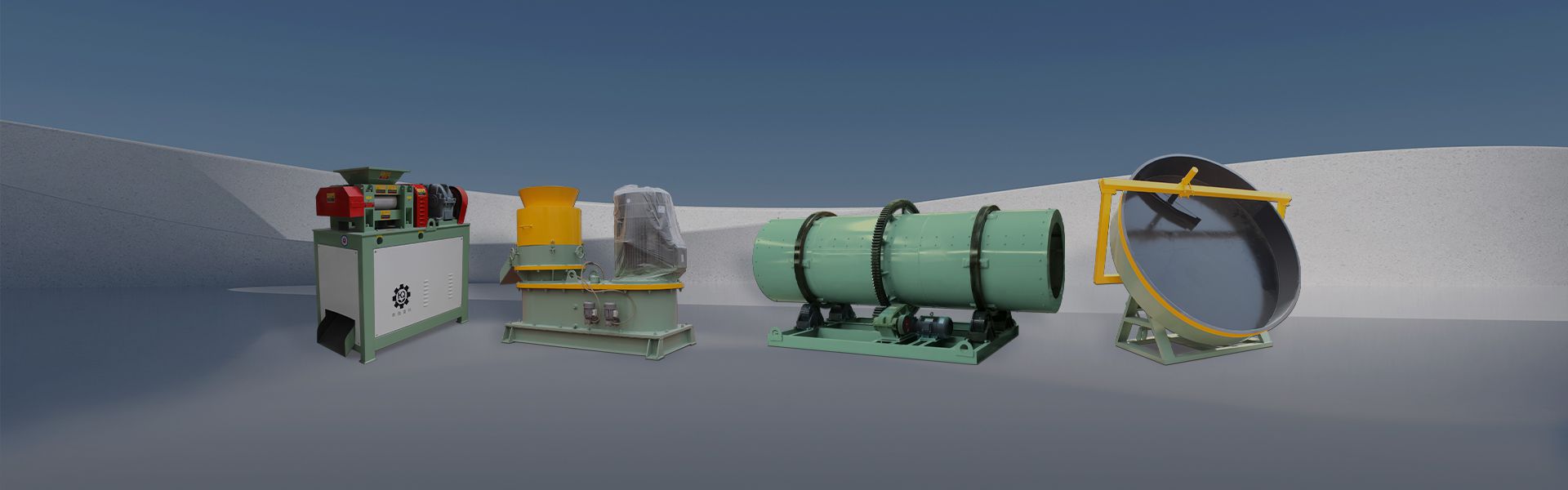
Controlling the moisture content of organic fertilizer fermentation at 30%-40% is essentially about maintaining a “capacity balance” for the entire production line. Too high a moisture content saves time in the fermentation stage, but forces the granulation and drying stages to handle all the dehydration, thus limiting the overall production capacity. Too low a moisture content inhibits microbial activity, resulting in incomplete decomposition. Uncomposted material entering the granulation stage can cause sticking and strength problems. 30%-40% is the range where the fermentation completion point overlaps with the granulation feed window. Controlling this range isn’t just a matter for the fermentation stage; it’s the starting point for matching the overall production capacity.
I. The Linkage Between Fermentation Moisture Content, Turning Frequency, and Cycle
Fermentation moisture content is not an isolated parameter; it directly determines the turning frequency and the decomposition cycle. Aerobic fermentation microbial activity relies on a water film as a metabolic medium. When the moisture content is below 30%, microbial reproduction is hindered, organic matter decomposition is slow, the pile temperature doesn’t rise, and the decomposition cycle is prolonged. If the moisture content is too high (over 60%), the gaps between particles will be filled with water, resulting in a dense pile, insufficient oxygen supply, and a shift towards anaerobic conditions, producing odors and prolonging degradation time.
The frequency of turning the pile depends on the moisture content and temperature. During the secondary fermentation stage, turning can be stopped when the pile temperature drops to around 40℃ and the moisture content falls to 30%-40% (no more water overflows when the material is squeezed by hand), completing the composting process. Conversely, if the moisture content is still too high at the end of fermentation, turning cannot be stopped—the turning machine is responsible not only for supplying oxygen but also for evaporation and dehydration. The further the moisture content deviates from the target range, the more frequent the turning must be, leading to a simultaneous increase in the fermentation cycle and energy consumption. The material is only suitable for entering the pulverizing process when the moisture content is controlled below 30% after composting; this is the moisture condition for the transition from the fermentation stage to the granulation stage.
II. Strategies for Remixing and Adjusting Auxiliary Materials for High-Moisture Materials
When the moisture content of the raw materials is out of control, the most direct adjustment method is remixing and blending with auxiliary materials. Remixing involves combining pre-fermented, low-moisture materials (approximately 30% moisture) with high-moisture fresh materials in a specific ratio, offsetting the dry and wet components to reduce the overall moisture content without increasing the cost of purchased auxiliary materials. For fresh materials such as chicken manure and cow manure with a moisture content exceeding 80%, remixing is the lowest-cost pre-conditioning method.
Auxiliary material adjustment considers both moisture and carbon-nitrogen ratio. When moisture is too high, adding dry materials such as straw powder, sawdust, mushroom residue, and rice husks absorbs excess moisture while improving the bulkiness and aeration of the compost pile. The selection of auxiliary materials must consider the subsequent granulation process: straw-based auxiliary materials have long fibers, which, if not pre-cut to below 5 mm, will entangle and jam in the granulation stage; sawdust and mushroom residue have finer particle sizes, causing relatively less interference with granulation. Remixing addresses the issue of “excessive moisture,” while auxiliary materials address “excessive moisture and poor structure.” Using both in combination is more stable than relying on only one method.
III. The Connection Between Fermentation Moisture and Granulation Path Selection
The final moisture content at the fermentation endpoint directly determines whether the granulation path can be successfully implemented. The feed window for wet disc granulation is typically 30%-40%, allowing fermented material with a moisture content of 40% to be fed directly into the discs. Fine-tuning is achieved through atomized spraying, with a low-temperature drying step only needed if the finished product’s moisture content is below standard. Roller extrusion and flat die extrusion are dry or semi-dry processes, requiring an infeed moisture content of 15%-25%. Fermented material must be dehydrated or mixed with dry material before entering the extruder. Chicken manure compost typically has a moisture content of 30%-50%, requiring drying to below 20% before extrusion granulation. The advantage of “extrusion without drying” is significantly diminished on chicken manure production lines.
This means that controlling fermentation moisture content requires considering not only “how much water is needed for fermentation” but also “how much water can the granulation process handle.” When fermentation moisture content is stable at 30%-35%, wet disc granulation can directly handle the material, requiring only fine-tuning in the drying section. When fermentation moisture content exceeds 40%, the wet process can still accommodate it, but the dry process is forced to add a pre-drying stage, altering the overall energy consumption structure of the production line. Every extra bit of moisture retained in the fermentation stage increases the workload on the drying stage; capacity matching is calculated segment by segment along this moisture chain.
IV. FAQ: How to handle uncontrolled raw material moisture during the rainy season?
Q: Continuous rainfall causes the moisture content of incoming raw materials to soar, disrupting both fermentation and granulation stages. What emergency measures should be taken?
First, implement physical isolation to prevent further moisture from entering the system: Reinforce the fermentation site, cover it with rainproof film, and leave 10-15 cm ventilation gaps around the perimeter. Complete sealing is strictly prohibited to prevent anaerobic suffocation. Clear drainage ditches to prevent backflow of water. Second, separate high-moisture raw materials from normal raw materials, testing the moisture content batch by batch to prevent batch-wide loss of control due to high-moisture material mixing with normal material. Third, use dry auxiliary materials or dry return materials for emergency remediation, bringing the incoming moisture content back to the 50%-60% fermentation start-up window. Simultaneously, increase the frequency of turning and tossing to once every 2-3 days to aid dehydration through evaporation. The fourth step involves using a transfer silo between fermentation and granulation to buffer moisture fluctuations and prevent high-moisture material from directly impacting the granulation section and causing blockages. If the granulation section has already been forced to shut down, priority should be given to ensuring the normal operation of the fermentation section. Granulation should only resume after the moisture content has decreased, rather than “toughing it out” with high-moisture material inside the granulator. The core principle of emergency response during the rainy season is to prevent moisture from entering the fermentation process, rather than relying on the drying section to absorb the excess moisture.
V. Matching Turning Equipment to the 30%-40% Moisture Window
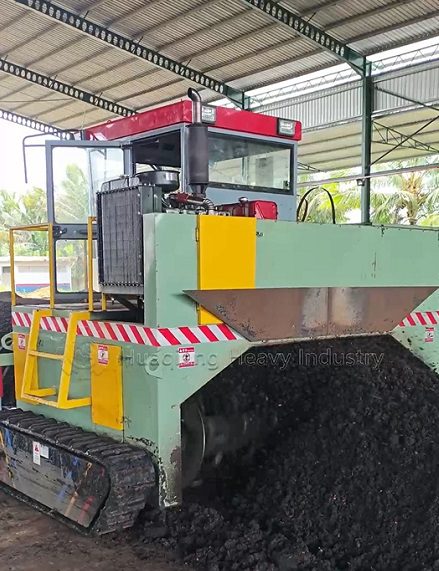
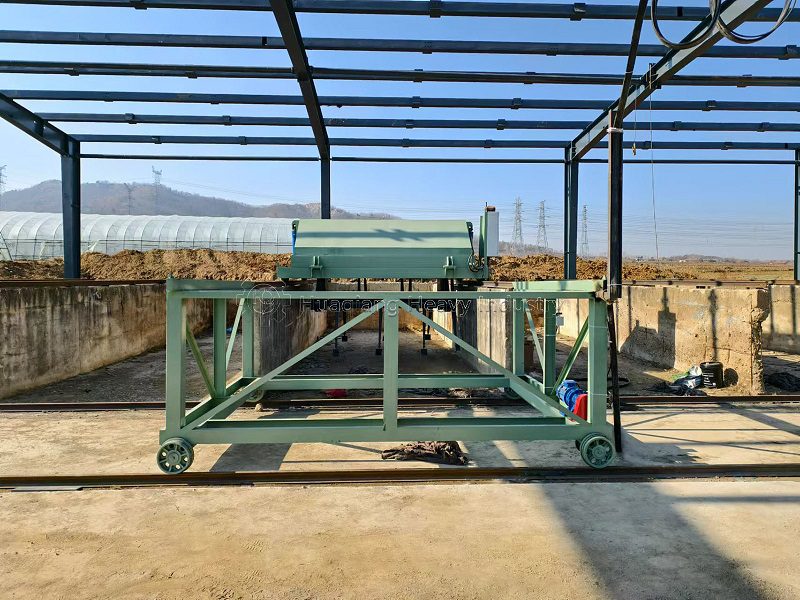
Maintaining the 30%-40% moisture window also depends on the turning equipment used to supply oxygen and remove water. Fermentation composting turning technology determines how evenly the pile is aerated and how much moisture is evaporated per turning pass; trough-type fermentation composting technology is suitable for controlled, automated scheduling where moisture and temperature data drive turning tasks. For larger open piles, a windrow composting machine can handle frequent turning and promote evaporation, while a large wheel compost turner provides deeper turning and aeration for high-moisture material. The equipment choice should match the moisture control target: the further the pile deviates from 30%-40%, the more the turning capacity and evaporation effect matter. In this sense, moisture control is not only a fermentation parameter but also a equipment-matching decision along the production line.
The 30%-40% moisture content for organic fertilizer fermentation, while seemingly a fermentation parameter, is actually a capacity balance line drawn across the entire production line, balancing fermentation and maturation, turning and turning cycles, auxiliary material adjustments, and granulation feed. Maintaining this line ensures adequate fermentation and maturation, allows for selective granulation, and prevents the drying section from becoming a bottleneck.