
The answer depends on the control system and scheduling design. A high-efficiency trough-type compost turner equipped with PLC programming control can manage 5-8 fermentation troughs, achieving unattended continuous operation. The number of troughs managed is constrained by the trough length, turning speed, and the degree of automation of the control system. The core is not “human supervision,” but rather allowing the machine to decide “which trough to go to and when to go” according to the fermentation rhythm.
I. Control Logic of One Machine for Multiple Turfs
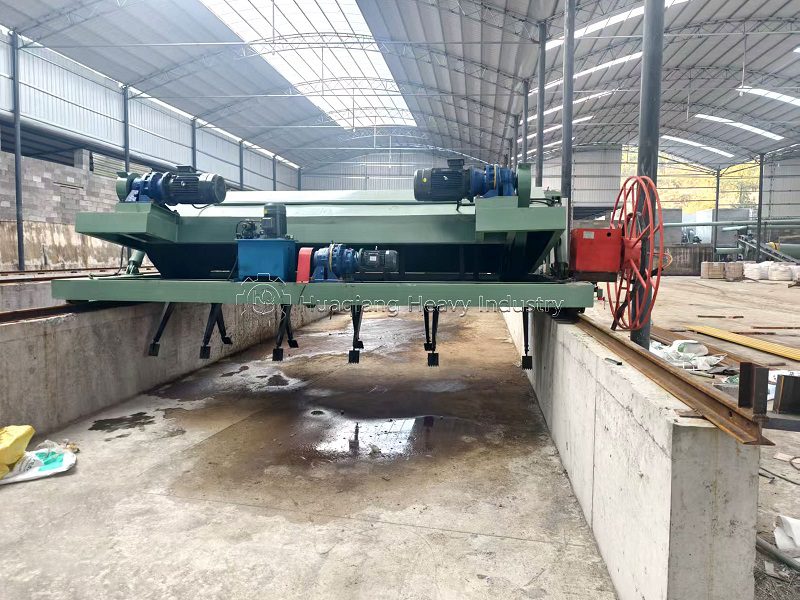
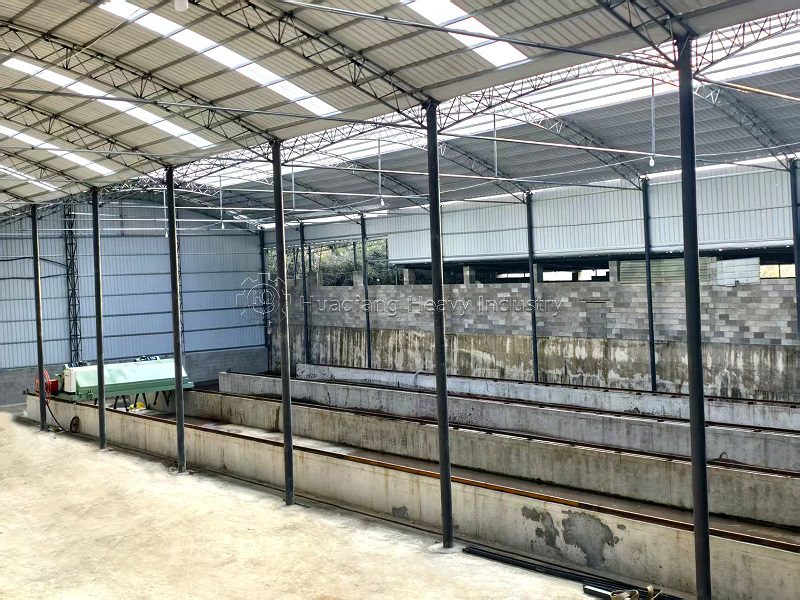
The physical basis of one machine for multiple troughs is the transfer machine (trough-changing cart): After the main compost turner completes the turning of the current trough, the rollers or chain plates are raised to a safe height, the main machine retreats to the transfer platform at the end, the platform moves laterally to the track docking position of the target trough, and the main machine enters the new trough to continue operation. The entire process is automatically controlled by PLC, with a trough-changing positioning accuracy of ±5 mm. Switching from one trough to another usually only takes 3-5 minutes.
However, “being able to change troughs” does not equal “good management.” The scheduling logic truly determines how many troughs one person can manage. In aerobic composting, newly fed troughs are turned frequently (1-2 times daily for the first 7-10 days), decreasing in frequency after entering the maturation stage. A reasonable approach is to keep multiple troughs at different fermentation stages, creating staggered demand: for example, out of 6 troughs, 2 are in the high-frequency stage, 2 in the medium-frequency stage, and 2 in the low-frequency stage. A single turning machine can cover these troughs in rotation according to a schedule, preventing “equipment contention.” The central control system can automatically generate a turning task queue based on temperature sensor data from each trough, achieving unmanned scheduling. The PLC’s role here is to translate “temperature data” into “turning instructions,” rather than waiting for decisions.
II. Turning Cycle and Turough Number Scheduling
The upper limit of the number of troughs can be estimated using a simplified working time model. If it takes 1 hour to complete one round of turning in one trough, and the effective working time is 8 hours per day, theoretically, 8 turnings can be completed per day. Combining this with the actual turning frequency required for each trough, the maximum number of troughs that can be managed can be calculated. For example, if each tank is turned once a day, 8 operations can cover 8 tanks; if each tank needs to be turned twice a day during high-temperature periods, the coverage capacity drops to 4 tanks. The longer the tank and the longer the turning time per operation, the fewer tanks it can handle. For highly viscous materials like chicken manure and sludge, the turning resistance is high, so it should ideally be controlled to 2-3 tanks, leaving a buffer margin.
In industry practice, a conventional track-mounted turning machine typically handles 2-4 tanks for small to medium-sized projects. In small projects with short tanks and low output, one machine can handle 5 tanks, but this can lead to queuing for turning, potentially affecting the fermentation and heating rhythm. Large systems equipped with PLC fully automatic control and a transfer machine, through staggered scheduling and 24-hour continuous operation, can extend the management range of a single machine to 5-8 tanks, provided the tank length is appropriate, material resistance is controllable, and the scheduling has a buffer.
III. Minimum Frequency of Manual Inspection
“Unattended operation” does not equal “unattended inspection.” PLCs can automatically cycle through turning, lifting, moving, and fault alarms, but the tightness of the cutter head bolts, bearing temperature and lubrication status, and whether there are foreign objects entangled in the tracks still require human inspection. A reasonable inspection frequency is once per shift, focusing on checking for missing, loose, or foreign object-entangled cutters and bolts; injecting lithium-based grease into the traveling bearings and chains weekly; and investigating lubrication or wear issues if the bearing temperature exceeds 60℃. One person manages 5-8 tanks; their daily workload is not on “operating the equipment,” but on “inspecting equipment status, handling alarms, and replenishing lubrication.” This is a reasonable division of labor achieved by PLCs after freeing operators from the manual labor of changing tanks.
IV. FAQ: Will multiple tanks on one machine cause delays?
Q: If a turning machine manages multiple tanks, and it’s time to turn one tank but the machine is operating in another, will this delay fermentation?
No, under normal scheduling, provided the staggered operation design is in place. The feasibility of a single machine handling multiple tanks relies on the time lag in the turning and turning requirements of each tank: different tanks are in different stages—heating, high-temperature, and cooling—and therefore the turning and turning frequency varies. The PLC prioritizes tasks according to a task queue, placing urgent needs (such as tanks in the high-temperature stage) first and non-urgent needs (such as tanks in the cooling stage) in the gaps. The real issue of “mutual waiting” arises when scheduling is not staggered—multiple tanks simultaneously entering the high-temperature stage and requiring high-frequency turning and turning will inevitably cause delays regardless of how a single machine is scheduled. The solution is not to increase the speed of the equipment, but to stagger the fermentation stages of each tank in the feeding rhythm, allowing the turning and turning requirements to be evenly distributed along the timeline. If project capacity requirements do not allow for staggered scheduling and multiple tanks must be turned and turned at high frequency simultaneously, the correct choice is one machine per tank or increasing the number of main units, rather than expecting one machine to “run faster.”
V. From Single Machine to System: Equipment and Technology Integration
The 5-8 trough coverage is not achieved by a standalone machine but by integrating fertilizer composting turning machine equipment with fermentation composting turning technology. When selecting a trough-type compost turner, its transfer cart, PLC scheduling, and turning capacity must be matched to trough length and material resistance; when designing a trough-type compost turner fermentation system, the feeding rhythm, temperature-driven task queue, and inspection plan should be treated as one system. In this sense, one person managing multiple troughs is a system-level outcome: the equipment provides the physical range, the composting technology provides the scheduling logic, and routine inspection maintains the baseline condition.
Managing multiple tanks with a single person using a trough-type turning and turning machine appears to be a matter of equipment quantity, but at its core, it’s a scheduling design problem. The PLC and transfer machine provide the physical capacity for 5-8 slots. Off-peak feeding and temperature-driven task queues make this capacity available, while routine inspections per shift maintain the equipment’s baseline condition. Treating these three layers separately, with one person handling multiple slots, is the only feasible production solution, not just theoretical parameters.