
The belt conveyor serves as the material “artery” of a fertilizer production line; failure to promptly address belt misalignment can lead to edge wear, material spillage, and even system shutdowns. A systematic approach to preventing misalignment involves three key areas: installation and adjustment, operation and maintenance, and automatic correction.
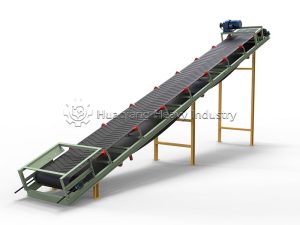
Installation and Adjustment: The conveyor frame must be installed with a horizontal straightness error of no more than 2 mm/m. The axes of the head and tail pulleys must be perpendicular to the direction of belt travel, with a parallelism deviation of ≤0.5 mm. Belt splices must be straight; hot vulcanization (achieving >90% of the original belt strength) is recommended over mechanical fasteners, as skewed splices are a primary cause of misalignment. During installation, idler positions should be adjusted under no-load conditions to ensure the belt runs centrally on the pulleys, maintaining a difference of ≤10 mm between the belt edge and the pulley edge.
Operation and Maintenance: Material discharge points should be centered over the belt to prevent off-center loading, which causes misalignment. Adjustable baffles should be installed within the discharge hopper to guide material to the center of the belt. During routine shift inspections, monitor the belt’s tracking path; if deviation is detected, self-aligning idlers (typically adjustable within a ±5° range) can be fine-tuned to compensate. Belt tension must be optimal—excessive slack leads to slippage and misalignment, while excessive tension increases bearing loads and accelerates belt fatigue. A gravity-type tensioning device is recommended to automatically maintain constant tension. Weekly cleaning of idler and pulley surfaces is essential, as material buildup increases the effective diameter at specific points, causing the belt to shift laterally.
Automatic Correction Systems: For long-distance conveyor lines (exceeding 50 meters), the installation of a hydraulic automatic correction system is recommended. When the belt drifts and triggers a limit switch, a hydraulic cylinder automatically adjusts the idler angle to steer the belt back to the center, with a response time of ≤2 seconds. When conveying organic fertilizer (which is highly adhesive), scraper cleaners and return-strand cleaners should be installed on the return belt to prevent material carryback from causing idler adhesion and belt mistracking. A tracking log should be established to track the frequency and causes of belt misalignment across all conveyor lines; targeted modifications should be implemented for areas with high misalignment frequency to ensure the long-term, stable operation of the conveying system and guarantee production continuity.