
In modern fertilizer and building materials production lines, the smooth, continuous conveyance of materials is the lifeline of efficiency. Among the many conveying equipment options, the Screw Conveyor stands out for its simple, reliable, and highly flexible method of transport. Like a silent yet powerful “steel artery,” it precisely drives the pulse of production within enclosed spaces.
Core Principle: The “Elegant Thrust” of a Rotating Spiral
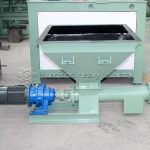
At the heart of a screw conveyor lies a rapidly rotating spiral shaft within a U-shaped or tubular trough. As the spiral flights rotate, material caught between the flights and the trough wall is subjected to axial thrust and radial restraint, causing it to move steadily along the preset direction of the screw, much like a nut being turned. This seemingly simple principle grants it unparalleled containment, directional flexibility, and controllability.
Four Core Advantages: Why It’s the Preferred Choice in Many Scenarios
Superior Containment: Operating entirely within a sealed trough or pipe, it virtually eliminates dust emission and material contamination, perfectly meeting requirements for environmental protection and clean production. It is especially suitable for handling powdered, granular, or mildly toxic materials.
Exceptional Layout Flexibility: It can accomplish horizontal, inclined, and even vertical conveying, easily navigating around obstacles and adapting to complex, confined factory spaces. In contrast, belt conveyors are typically limited to fixed-angle, planar transport.
Multifunctional Integration: It is more than just a conveyor. During transport, it can simultaneously perform tasks like mixing, stirring, heating, or cooling the material. Specially designed spiral flights can also enable precise metering and feeding.
Simple Structure, Easy Maintenance: The main moving parts are only the spiral shaft and bearings, resulting in low failure rates and easy maintenance. Operational costs are significantly lower than complex systems like pneumatic conveying.
Key Role in Fertilizer Production Lines
The screw conveyor acts as the “ligament” connecting major pieces of equipment. For example:
Feeding Stage: Stably and quantitatively conveying crushed raw materials to the mixer.
Process Connection: Evenly feeding wet granules from the granulator into the drum fertilizer dryer, or smoothly transferring dried granules to the cooler.
Finished Product Handling: Enclosed and dust-free conveyance of screened, qualified fertilizer granules to the packaging silo.
It perfectly complements bucket elevators (specialized for high-angle vertical lifting) and belt conveyors (ideal for long-distance, high-volume horizontal transport), together forming an efficient, three-dimensional material flow network.
Technological Evolution: Towards Intelligence and Specialization
The modern screw conveyor is no longer a simple “spiral + tube.” To address different material characteristics (such as stickiness or abrasiveness), innovative designs like shaftless screws (solving wrapping issues) and twin screws (enhancing mixing and conveying capacity) have been developed. Intelligent control systems allow for precise speed adjustment, enabling synchronized start-stop and flow matching with upstream and downstream processes, making it an indispensable intelligent unit in automated production lines.
Conclusion: The Silent Foundation, The Guarantee of Flow
The screw conveyor may lack the “shaping” capability of a granulator or the “transforming” power of a dryer. Yet, through its most fundamental and reliable mechanical principle, it ensures the continuous, stable, and controlled flow of materials within the production bloodstream. It is the physical cornerstone of production fluency, the unsung hero connecting every process step. Choosing a well-designed screw conveying system means endowing your entire production system with reliable and efficient circulatory power.