
The Essence of Aerobic Fermentation: A Three-in-One Biological Reaction
The essence of organic fertilizer fermentation is the process by which aerobic microorganisms decompose organic matter under suitable conditions. Oxygen, temperature, and microorganisms constitute the three pillars of aerobic fermentation, none of which can be dispensed with. The compost turner was developed precisely to artificially regulate the relationship between these three factors—it mechanically turns the compost pile, introducing external oxygen into the interior while expelling accumulated heat, water vapor, and carbon dioxide, and simultaneously exchanging the positions of the surface and bottom layers of material, making fermentation more uniform.
The Four Stages of Fermentation and the Role of the Compost Turner in Regulation
Heating Phase (Pile temperature rises from room temperature to 50℃): Mesophilic microorganisms are the first to activate, decomposing easily degradable organic matter and releasing heat. At this time, the primary task of turning the pile is to mix the materials evenly and homogenize the inoculation. It is recommended to perform the first turning on the 2nd-3rd day after composting, and then turn it every 2 days thereafter.
High-temperature stage (pile temperature 55-70℃): Thermophilic bacteria become the dominant organisms, complex organic matter such as cellulose and hemicellulose is decomposed, and pathogens and weed seeds are inactivated. This high-temperature stage is the core of aerobic fermentation. During this stage, the turner has a dual role of supplying oxygen and controlling temperature—regularly turning the pile to replenish oxygen and maintain microbial activity; and turning to dissipate heat when the pile temperature exceeds 70℃, preventing the inhibition of thermophilic bacteria activity. It is recommended to turn the pile once a day during the high-temperature stage for 5-10 consecutive days.
Cooling stage (pile temperature drops from 55℃ to near ambient temperature): Easily degradable organic matter is almost completely consumed, and microbial activity weakens. The focus of turning shifts to dissipating moisture and loosening the material. It is recommended to adjust the turning frequency to once every 2-3 days for 7-10 consecutive days.
Maturation stage (pile temperature stabilizes near room temperature): The turning frequency can be further reduced to once a week, mainly for checking the condition of the pile.
III. Aerobic Fermentation Curve and Turning Intervention An ideal aerobic fermentation curve follows a “rise-stabilize-decline” pattern: the temperature rapidly rises to above 55℃ within 2-3 days after piling; the high-temperature period lasts at 55-70℃ for 5-10 days; then it slowly decreases to room temperature. When the core temperature of the pile consistently exceeds 70℃ without a downward trend, turning the pile is the only effective intervention. Without turning, oxygen depletion leads to anaerobic fermentation; without turning, localized overheating kills beneficial bacteria; without turning, moisture cannot dissipate effectively—each intervention of the turning machine on this temperature curve corrects and ensures the direction of fermentation.
Recommended Turning Frequency Days 0-3 (Start-up Phase): The first turning after piling should be performed on days 2-3 to promote material mixing and uniform distribution of aerobic bacteria.
Days 4-14 (High-Temperature Period): Turn the pile once daily to maintain oxygen supply and control the core temperature at 55-70℃. Days 15-25 (Cooling Period): Turn the compost pile every 2-3 days, gradually reducing the intensity of turning to promote moisture loss.
Day 26 to Maturity: Turn the compost pile once a week, primarily to check its condition.
Summary: The compost turner is a key tool for artificial control in organic fertilizer fermentation. It provides oxygen to microorganisms, dissipates heat from the pile, homogenizes the material, and separates moisture—simultaneously performing four functions on a single machine: oxygen supply, temperature regulation, mixing, and moisture dissipation. Fermentation without a compost turner is left to chance; fermentation using a compost turner effectively is controlled and highly efficient production.
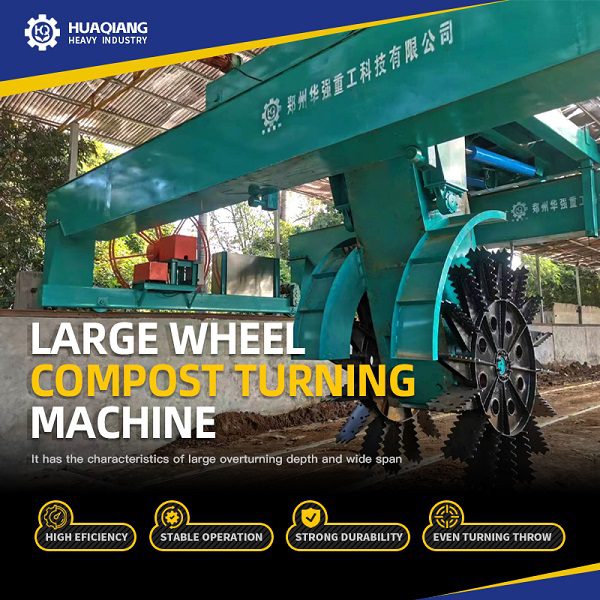
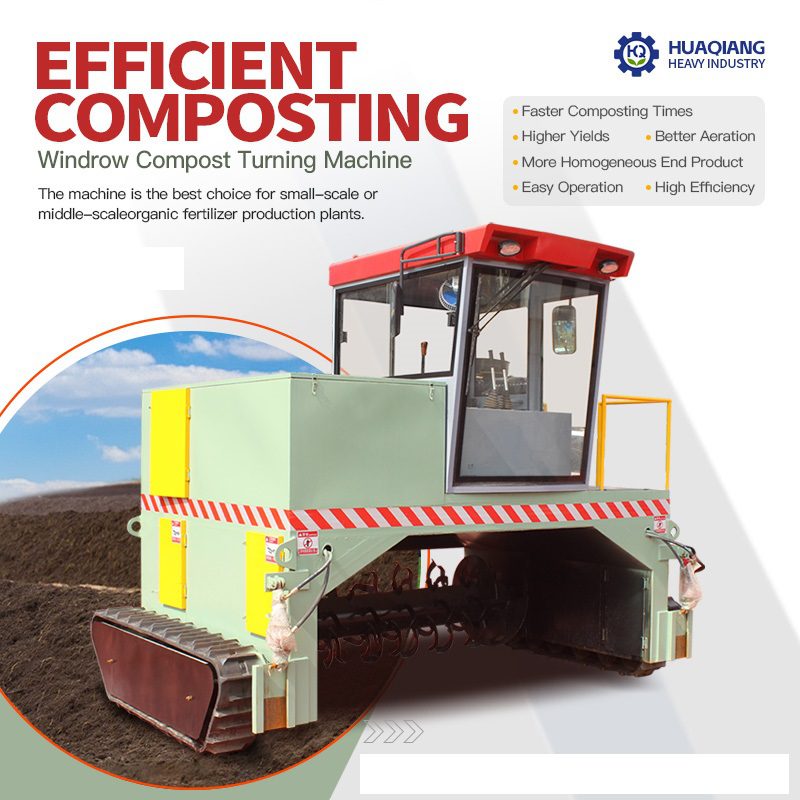
The compost turner is far more than a simple mechanical device—it is the central nervous system of the fermentation composting turning technology that governs the entire composting process for animal manure. Whether you choose a trough-type compost turner for fixed, high‑capacity operations, a large wheel compost turning machine for deep‑turning and rapid aeration, or a windrow composting machine for flexible open‑air composting, each type serves the same critical functions: supplying oxygen, regulating temperature, homogenizing the material, and removing excess moisture. These interventions are not optional—they are essential to guide the fermentation curve through its four stages (heating, thermophilic, cooling, and maturation) and to ensure that the pile temperature stays within the optimal 55‑70°C window for the required duration. Without regular turning, anaerobic conditions develop, odors intensify, pathogens survive, and nutrient losses increase—compromising the entire fertilizer manufacturing process. With proper turning frequency (daily during the thermophilic phase, then gradually reduced), the compost turner transforms raw manure into stable, mature, pathogen‑free organic matter that is ready for downstream processing—whether that be disc granulation production line for spherical pellets, blending with inorganic nutrients, or direct packaging as a soil amendment. In essence, the fertilizer composting turning machine equipment is the bridge between waste and resource—it turns a biological process that would otherwise take months into a controlled, efficient, and predictable industrial operation, delivering consistent quality and maximum economic return for organic fertilizer producers.