
Whether a compost windrow turner can ferment materials effectively depends not on the sophistication of the turner itself, but on three upstream decisions: how to determine the pile cross-section, how to match the height and width with the equipment, and what signals guide the turning frequency. These three factors should be fixed before the equipment arrives on site, rather than waiting until the material is turned and shows signs of “no heating or localized anaerobic conditions” before adjusting the machine.

Pile Shape: Trapezoidal or triangular, width initially conforming to the turner’s specifications.
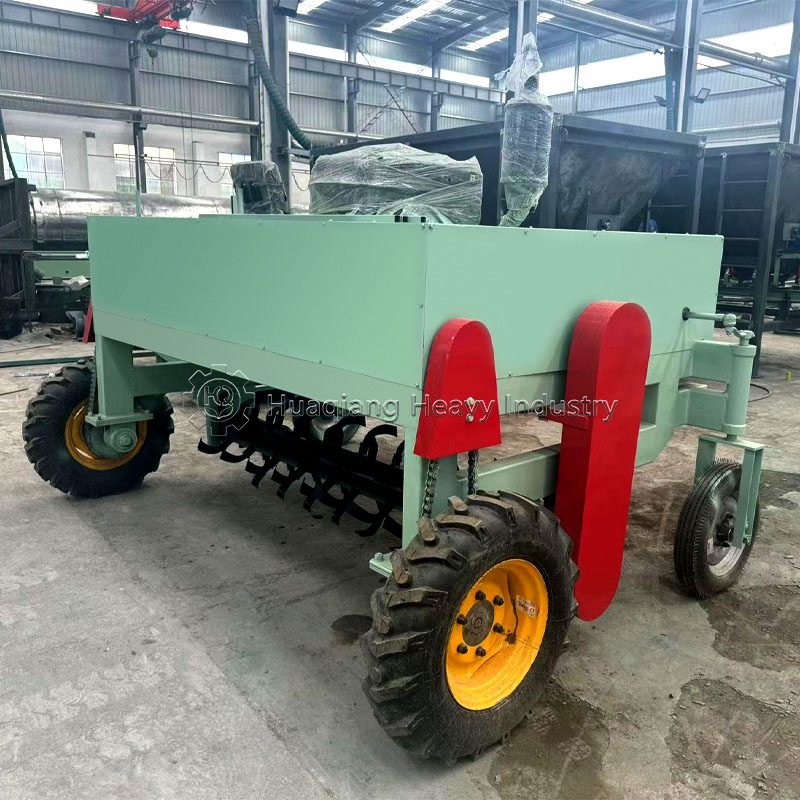
The cross-section of the windrow is not an aesthetic issue. Common shapes are trapezoidal or semi-circular, 2-3 m wide, 0.8-1.5 m high, with the length determined by the site conditions. The advantage of a trapezoidal shape is slope stability, preventing material from scattering during turning, and allowing the cutter roller to completely turn the entire cross-section. A strict constraint is that the pile width must match the effective working width of the turner. A 2.5 m wide compost turner should be stacked to a 2.5 m wide pile; for models with a width of 2.4-3.0 m, the corresponding pile width is 2-3 m. If the pile is wider than the equipment, the edge material becomes a “dead zone,” where it cannot be turned over for a long time, and anaerobic and foul odors begin to emanate from there. A 0.8-1.0 m walking space should be left between adjacent piles; otherwise, if the compost turner operates close to the edge of the pile, deviation will directly reduce the effective turning depth.
Height and Depth: Higher isn’t always better; exceeding 1.5 m requires careful consideration.
The pile height is constrained by two factors simultaneously: the rated turning depth of the equipment and the pile’s own ability to maintain porosity. The conventional turning depth of small and medium-sized windrow compost turners is concentrated between 0.8-1.5 m, while tracked models can reach 1.2-1.8 m. Further depths require larger equipment. However, even if the equipment can reach the pile, it is not advisable to blindly increase its height. Beyond 1.5 m, the bottom material experiences significantly increased compaction from above, porosity is compressed, and resistance to oxygen diffusion to the center rises sharply. The bottom temperature easily drops below 50°C, leading to poorer uniformity of fermentation. A repeatedly verified boundary is that maintaining an aerobic state through turning and tossing is least costly when the pile height does not exceed 1.5 m; beyond this height, either a deeper turning device is needed, or the risk of delayed bottom fermentation must be accepted. Shape and size are interconnected here: too wide and the edges won’t be compacted; too tall and the bottom won’t be compacted.
Turning and Tossing Frequency: Set the rhythm in the first week, then let temperature dictate.
There is no “standard answer” to the turning and tossing frequency, but there is a clear starting window and a switching logic. The first week is the critical period for temperature increase; turning 2-3 times aims to mix the material evenly, introduce oxygen, and break up localized anaerobic areas. Once the high-temperature period begins, the frequency is no longer based on a fixed number of days, but rather determined by the pile temperature: the ideal range is 55-65℃. Above 70℃, turning and tumbling are necessary for heat dissipation; below 50℃, the oxygen supply and moisture content should be checked. During the stable high-temperature phase, once a week or every 3-5 days is a common rhythm. This “increased frequency followed by decreased frequency” logic is essentially the core operational principle of fermentation composting turning technology in a windrow scenario: turning is to trigger and maintain high temperatures, not just turning for the sake of turning.
There is a misconception that must be corrected: turning itself is not the primary means of oxygen supply. The fresh air introduced by turning will be depleted by microorganisms within a few hours in an active pile. What truly allows oxygen to penetrate deep into the pile is the pile’s own porosity. What maintains porosity? The looseness of the bedding and auxiliary materials, the appropriate moisture content, and the fact that the pile is not crushed. Therefore, when anaerobic conditions occur in the compost pile, the first reaction should not be to “increase the number of turnings,” but rather to check if the pile height is too compacted, if the material moisture content exceeds 65%, and if sufficient additives have been added. Turning frequency is a means of adjustment, not a fundamental solution. This judgment logic also applies to the daily operation of windrow composting machines and is the basis for the stability of the fermentation stage in the organic fertilizer production process.
The width, turning depth, and applicable pile types of windrow composting machines can be found on the product page. The scale boundaries of the three fermentation systems can be compared between large-wheel vs. trough vs. windrow composting selection. Providing three pieces of information—daily processing capacity, material type, and existing site dimensions—allows for direct matching of the composting machine width and pile parameters.