
Traditional natural composting takes as long as 60 days or even longer. The fundamental reason lies in the insufficient number and low activity of microorganisms decomposing organic matter in the natural environment, coupled with poor oxygen supply within the compost pile. By deeply integrating exogenous fermentation microorganisms with mechanized compost turning equipment, this cycle can be significantly reduced to approximately 15 days. This “hardware-software synergy” is the core secret to the high-efficiency production of modern organic fertilizer plants.
Microbial Agent Addition: Providing an “Accelerating Engine” for Composting
Fermentation microorganisms are the biocatalysts for organic fertilizer fermentation. High-quality compound microbial agents (such as those containing Bacillus subtilis, Bacillus stearothermophilus, and cellulose-decomposing bacteria) can multiply rapidly in a short time, quickly decomposing large organic molecules such as cellulose and proteins.
Regarding the dosage, authoritative research provides a clear reference range: the recommended dosage of beneficial microbial agents in the initial stage of fermentation is 0.1% to 5.0% of the total material. In practical engineering, a common approach is to add approximately 1 kg of microbial agents per 10 to 20 tons of manure raw material. If using a premixed method of microbial inoculum and auxiliary materials, it can be diluted at a ratio of 1:5 (1 kg of microbial inoculum to 5 kg of wheat bran or rice husk powder) and then evenly spread. It is worth emphasizing that adding exogenous microbial agents can significantly shorten the fermentation cycle and effectively promote the composting and humification process—the selected high-efficiency microbial agents can even shorten the fermentation cycle by 38 days.
Turning Frequency Curve: Precise Control in Stages
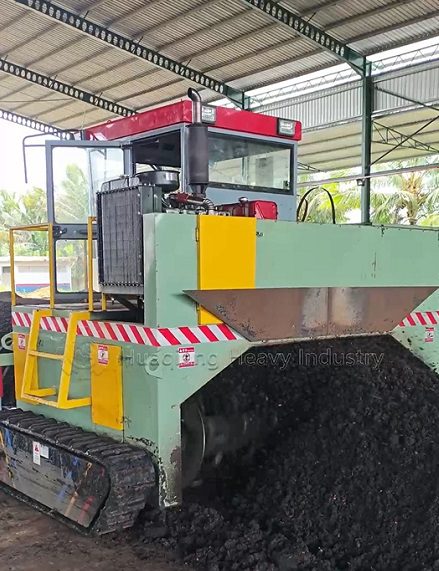
The role of the turning machine is not only to “turn the material,” but also to act as a three-in-one process executor of oxygen supply, temperature regulation, and humidity equalization. The turning frequency is not static but should be dynamically adjusted according to the fermentation process:
Heating Stage (3 to 7 days before fermentation): This is the peak period for aerobic bacteria, requiring turning 1 to 2 times per day. High-frequency turning ensures a continuous influx of fresh air into the pile, causing the pile temperature to rise rapidly to above 55℃. At this time, the oxygen content should be maintained at 10% to 15%.
High-Temperature Stage (Pile temperature 55 to 65℃): This is the critical window for pathogen inactivation and rapid degradation of organic matter. The turning frequency can be adjusted to once every 1 to 2 days. When the pile temperature exceeds 65℃, it should be turned over promptly to cool it down and prevent the functional bacteria from dying off due to overheating. The high-temperature period typically lasts 10 to 15 days.
Cooling and composting stage (late fermentation stage): As easily degradable organic matter is depleted, the turning frequency can be reduced to once every 2 to 3 days, focusing on maintaining the pile’s looseness and aeration to promote humus formation.
Studies show that when the carbon-to-nitrogen ratio is controlled at 25:1 and the turning interval is 4 days, the aerobic fermentation of cow manure heats up quickly, maintains the high temperature for a longer period, and significantly shortens the fermentation cycle. Using a trough fermentation system combined with a track-mounted turner, the fermentation cycle can be controlled within 18 to 25 days, 50% shorter than traditional composting. More advanced windrow aerobic fermentation processes can even shorten the cycle to 15 days.
III. Hardware and Software Synergy: From “Experience-Based Composting” to “Precision Manufacturing”
The combination of fermentation bacteria and the turner essentially unifies biological principles with mechanized methods into a controllable process system. The core value of this turnkey solution lies in two aspects: the microbial strain solves the problem of “who will decompose”—using highly active exogenous microorganisms to replace the natural microbial community; the compost turner solves the problem of “how to supply oxygen”—using mechanized precision turning to replace manual, extensive turning. Both are indispensable—without sufficient oxygen supply, aerobic bacteria cannot fully exert their activity; without the catalysis of highly efficient microorganisms, decomposition efficiency remains low.
For organic fertilizer producers, mastering the process combination of “microbial strain addition amount + turning frequency curve” means upgrading the fermentation process from uncontrollable “natural waiting” to controllable “precision manufacturing”—this is not only the secret to shorter cycles but also the fundamental guarantee for stable product quality and controllable production costs.
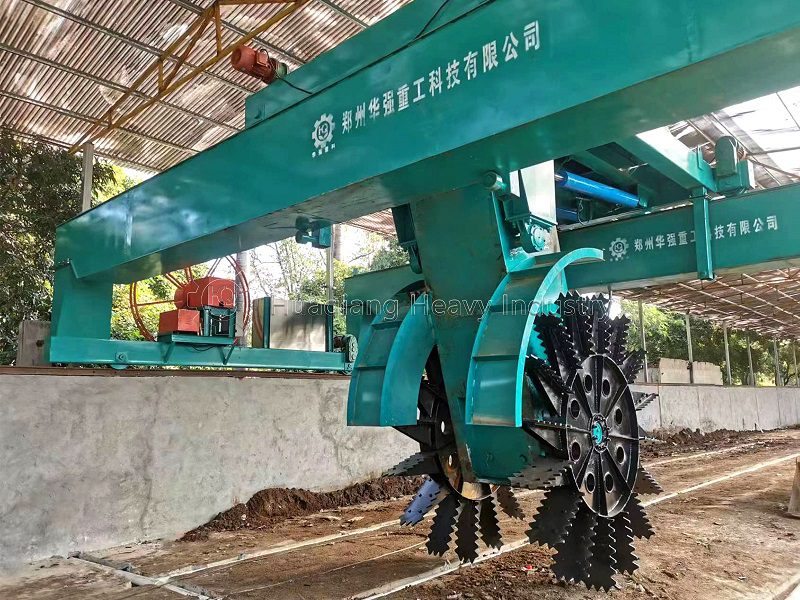
The synergy between microbial agents and mechanical turning is the cornerstone of modern composting, transforming a slow, unpredictable natural process into a fast, reliable, and controllable industrial operation. This integration is embodied in fermentation composting turning technology, which encompasses a range of equipment tailored to different scales and layouts. For large‑scale trough systems, the trough-type compost turner delivers precise, depth‑controlled aeration along fixed rails, ensuring uniform oxygen distribution and temperature regulation across the entire batch. Meanwhile, the large wheel compost turner offers high mobility and robust performance, ideal for operations that require frequent repositioning or handling of varied material volumes. For outdoor windrow operations, the windrow composting machine provides excellent maneuverability and turning capacity, making it the preferred choice for open‑air composting yards. When applied to specific waste streams, such as poultry litter, the chicken manure fermentation turning process benefits enormously from frequent, even turning combined with thermophilic microbial inoculants — reducing ammonia volatilisation, accelerating humification, and eliminating pathogens more effectively. The broader category of animal manure compost turner equipment, whether wheel‑type, trough‑type, or drum‑type, shares the same core mission: to maintain optimal oxygen levels (10‑15%), control peak temperatures (55‑65°C), and homogenise moisture and nutrients throughout the pile. When these turners are paired with high‑quality microbial consortia (e.g., Bacillus and cellulose‑degrading strains) at precise inoculation rates, the fermentation cycle consistently drops from 60 days to just 15‑18 days — a reduction that directly translates to higher throughput, lower operating costs, and superior product consistency. This hardware‑software integration is the essence of modern bio-organic fertilizer production technology, where every turn of the machine is a calculated intervention that replaces guesswork with data‑driven process control. Ultimately, mastering the combination of strain selection, inoculation ratio, and turning frequency curve allows producers to achieve not only rapid composting but also high‑quality humus with excellent maturity indices (GI ≥ 85%, C/N < 20), ensuring that the final bio‑organic fertiliser delivers consistent field performance, enhanced soil health, and reduced environmental footprint — a true paradigm shift from traditional farming to precision bio‑manufacturing.